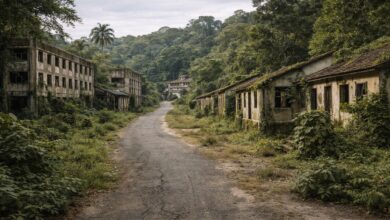
Few places in the world convey abandonment as clearly as Pripyat, a planned Soviet city built for workers of the nearby Chernobyl Nuclear Power Plant. Unlike ancient ruins shaped by centuries, Pripyat’s silence arrived suddenly. It was not worn down by time, but halted in a single moment, leaving behind apartments, schools, amusement rides, and personal belongings exactly where life last touched them.
Pripyat is often described as haunting, but its power lies not in fear or spectacle. It lies in interruption. The city represents a modern society stopped mid sentence, revealing how fragile routine, progress, and certainty can be when technology and human judgment collide.
A model city of the Soviet future
Pripyat was founded in 1970 as a model city. It was designed to house workers and engineers employed at the Chernobyl Nuclear Power Plant, along with their families. The city reflected Soviet ideals of modern urban life. Wide avenues, green courtyards, cultural centres, and schools were carefully planned.
With an average population age of just twenty six, Pripyat was young and energetic. Sports facilities, theatres, and cafes supported an active social life. Apartments were modern by regional standards, equipped with amenities that symbolized progress and stability.
The city’s proximity to the power plant was considered a sign of trust in nuclear technology. Chernobyl was seen as a cornerstone of national advancement, not a risk. Similar human responses to silence and environment appear in Bhangarh Fort.
The night that changed everything
On April 26, 1986, a reactor at the Chernobyl Nuclear Power Plant exploded during a late night safety test. The event released a massive amount of radioactive material into the atmosphere. In the hours that followed, confusion and incomplete information shaped the response.
Pripyat continued its normal routine that morning. Children went to school. People walked their dogs. Few residents understood what had happened nearby.
Only later did authorities decide to evacuate the city. Buses arrived on April 27, and residents were told they would return in a few days. They were advised to take only essentials. Most believed the displacement would be temporary.
They never came back.
Evacuation and absence
Within hours, nearly fifty thousand people left Pripyat. Apartments were locked. Meals were left unfinished. Toys remained on floors. The city emptied quickly and completely.
This sudden evacuation defines Pripyat’s haunting character. Unlike places abandoned through decline or conflict, Pripyat was abandoned intact. The absence feels deliberate because it was enforced.
The city became part of what is now known as the Chernobyl Exclusion Zone, an area where human habitation was restricted due to contamination. Time continued to move forward, but without people.
Architecture overtaken by nature
Over the decades, nature began reclaiming Pripyat. Trees grew through pavement. Vines climbed apartment blocks. Wildlife returned to spaces once dominated by human activity.
This transformation is slow and uneven. Some buildings remain structurally intact. Others are collapsing. Paint peels. Glass shatters. Floors weaken.
The city exists in a state between ruin and preservation. It is neither fully destroyed nor maintained. This in between condition adds to its emotional weight.
Nature’s return does not erase the city’s purpose. It contrasts with it.
The amusement park that never opened
One of Pripyat’s most recognizable symbols is its amusement park. A Ferris wheel, bumper cars, and rides stand rusted and motionless. The park was scheduled to open for May Day celebrations just days after the accident.
It never officially opened.
This detail has become emblematic of Pripyat’s story. The rides were built for joy and leisure, yet never served their purpose. Their presence highlights the abruptness of the evacuation.
They are not monuments. They are reminders of plans interrupted.
Life frozen in detail
Inside Pripyat’s buildings, small details carry enormous impact. Schoolbooks still lie in classrooms. Gas masks are scattered in hallways. Calendars mark dates long passed.
These objects are not curated exhibits. They are remnants. Their power lies in their ordinariness.
Pripyat shows how quickly normal life can become historical artifact. It compresses time, forcing visitors to confront how thin the line is between present and past.
Radiation and reality
Radiation remains part of Pripyat’s reality, though levels vary across the city. Some areas are safer than others. Access today is controlled and regulated.
The danger is not visible. This invisibility adds to the city’s unease. The threat that emptied Pripyat cannot be seen, smelled, or heard.
This disconnect between appearance and risk challenges human intuition. The city looks peaceful. The danger is abstract.
Memory, tourism, and ethics
In recent years, Pripyat has become a destination for guided visits. Photographers, researchers, and historians walk its streets under supervision. The city is often described as a monument to disaster.
This raises ethical questions. Pripyat was not abandoned by choice. It was taken from its residents. Their lives were displaced permanently.
The city’s silence is not consent. It is consequence.
Responsible engagement with Pripyat requires acknowledging that it is not an empty place, but a place emptied.
A symbol beyond borders
Pripyat has become a global symbol of technological risk and human vulnerability. It represents the limits of control and the long shadows cast by decisions made under pressure.
Yet it is also a story of ordinary people. Families. Children. Workers. Their absence gives the city its emotional weight.
Pripyat is not defined by catastrophe alone. It is defined by interruption.
Why Pripyat endures
Pripyat endures because it resists simplification. It is not merely a warning, nor only a ruin. It is a record of modern life paused without closure.
The city does not ask to be feared. It asks to be understood.
Walking through Pripyat today, one encounters not horror, but stillness. A reminder that progress is fragile, and that places can hold memory long after people are gone.
Pripyat remains, not as a ghost city, but as a silent witness to a moment when time was forced to stop. Related reflections on memory and perception can also be found in Isla de las Muñecas.
Horizon Report documents places shaped by memory, infrastructure, and human decisions. Our editorial approach focuses on what remains physically visible, how abandonment unfolds over time, and how interpretation is clearly separated from observable evidence.
For readers seeking deeper context, the following background articles explore how ghost towns emerge, why communities are left behind, and why preservation matters in understanding collective history.
- Abandonment And Ghost Towns
- What Is A Ghost Town
- Why Towns Are Abandoned
- Preserving Abandoned Places
Editorial transparency matters. Observations are grounded in site layout, materials, remaining structures, and documented timelines where available. Interpretive layers are presented as interpretation, not assertion.
Careful readers often notice details worth refining. Thoughtful feedback helps ensure accuracy, clarity, and long term editorial integrity.