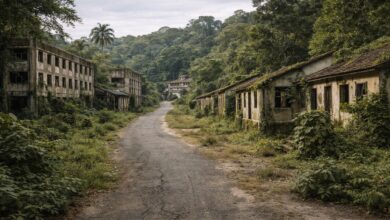
Just a short distance from the canals and palaces of Venice, Poveglia Island sits in near total silence. Boats pass within sight of its shoreline, yet few approach. The contrast is striking. One of Europe’s most visited cities lies minutes away, while Poveglia remains uninhabited, its buildings slowly decaying behind locked gates.
Poveglia’s reputation is often framed through sensational language, but its true weight comes from history rather than myth. The island’s past is defined by separation. For centuries, it functioned as a place where people were removed from society during moments of fear, disease, and uncertainty. Today, its abandonment continues that pattern, making Poveglia a rare example of a place where absence itself has become the defining presence.
An island shaped by necessity
Poveglia’s strategic position within the Venetian Lagoon made it valuable long before it became isolated. In early medieval periods, the island supported small settlements and defensive structures. Like many lagoon islands, it was part of a network that helped Venice manage trade routes, security, and population movement.
This role changed dramatically during outbreaks of plague. Venice, heavily dependent on maritime trade, was especially vulnerable to infectious disease arriving by ship. To protect the city, authorities developed strict quarantine systems. Poveglia became one of the locations used to isolate those suspected of carrying illness.
The island was not chosen for cruelty, but for practicality. Its separation from the city allowed authorities to control movement while maintaining proximity for supply and oversight. Still, the human cost of this system was significant. A related expression of this human response appears in Bhangarh Fort.
Quarantine and forced separation
During major plague outbreaks, individuals arriving in Venice were detained on islands like Poveglia before being allowed to enter the city. Some were travelers. Others were sailors, merchants, or local residents showing symptoms.
Quarantine periods could last weeks or longer. Many never returned to the city. Death was common, not only from disease but from exhaustion, fear, and inadequate medical understanding. Records from the era are incomplete, but archaeological evidence suggests large scale burial activity on the island.
Poveglia thus became associated with waiting. Waiting for permission. Waiting for recovery. Waiting for death. This prolonged uncertainty is central to the island’s lasting atmosphere.
Layers beneath the ground
Over time, Poveglia accumulated physical layers of its history. Soil mixed with ash. Structures were built, abandoned, and repurposed. Burial grounds were reused as foundations. The land itself became a composite of function and loss.
This layering contributes to modern perceptions of the island. Poveglia is not defined by a single event, but by repetition. Each era reinforced its role as a place removed from ordinary life.
The island did not host memorials or monuments. Its purpose was never reflection. It was containment.
Medical isolation in the modern era
In the eighteenth and nineteenth centuries, Poveglia’s role shifted again. As plague outbreaks diminished and medical theory evolved, the island was repurposed for medical isolation. Facilities were constructed to house patients deemed unfit to remain within the city.
Later, parts of the island were used for psychiatric care. Like many institutions of the time, these facilities operated under limited understanding of mental health. Treatment emphasized control and separation rather than recovery.
Documentation from this period is scarce, and many stories about conditions on the island are exaggerated or speculative. What is verifiable is that Poveglia continued to function as a place where society sent those it could not easily accommodate.
Closure and abandonment
By the mid twentieth century, medical facilities on Poveglia closed. Advances in healthcare and changing social attitudes made the island’s role obsolete. Unlike other parts of Venice, it was not redeveloped.
The island was simply left behind.
Buildings deteriorated. Roofs collapsed. Vegetation overtook courtyards and hallways. The bell tower, once used as a navigational marker, remained standing, overseeing empty ground.
Abandonment became permanent rather than temporary.
Proximity and contrast
One of Poveglia’s most striking qualities is how close it is to Venice. From certain vantage points, the city’s skyline is visible across the water. Gondolas and ferries move continuously nearby.
This proximity heightens the island’s emotional impact. Poveglia is not remote. It is deliberately excluded.
The lagoon around it is busy, yet the island remains untouched. This contrast reinforces the sense that Poveglia exists outside normal time, suspended between use and neglect.
Myth and modern perception
In recent decades, Poveglia has gained attention through media that emphasizes fear and haunting. These portrayals often simplify the island’s history, replacing complex social and medical realities with dramatic narratives.
Such interpretations overlook the more unsettling truth. Poveglia is disturbing not because of supernatural claims, but because it represents how societies respond to crisis. When fear rises, separation becomes policy.
The island reflects historical systems that prioritized collective safety over individual dignity. That legacy lingers in its empty structures.
Environmental stillness
Today, Poveglia is quiet in a way that feels intentional. Wind moves through broken windows. Birds nest in collapsed rooms. Trees grow where wards once stood.
Nature does not reclaim the island quickly. Salt air and water slow decay without restoring vitality. The result is a prolonged state of suspension rather than renewal.
This stillness contributes to the island’s reputation. It does not feel abandoned in the sense of neglect alone. It feels paused.
Ethical questions of reuse
There have been proposals to redevelop Poveglia. Some suggest tourism. Others propose private ownership or cultural preservation. Each idea encounters resistance.
The ethical challenge lies in purpose. How does one reuse a place so closely associated with suffering without erasing that history or exploiting it.
So far, no solution has been fully accepted. The island remains closed, its future unresolved.
Absence as memory
Poveglia’s power lies in what is missing. There are no residents to reinterpret its story. No daily routines to overwrite its past. Absence preserves meaning.
This makes the island different from restored historical sites. It has not been curated into comfort. It has been left as consequence.
Visitors are not invited to consume its story. They are kept at a distance.
Why Poveglia endures
Poveglia endures in public imagination because it embodies a recurring human pattern. When societies face danger they isolate. They draw boundaries. They choose places to hold uncertainty.
The island is not unique in function, but it is rare in preservation. Most such sites were erased or transformed. Poveglia remains intact enough to be unsettling.
Its silence speaks not of mystery, but of continuity. The same mechanisms that created it still exist in different forms. This form of symbolic separation appears in more than one setting, one of them being Isla de las Muñecas.
A place between water and memory
Ultimately, Poveglia Island is not a symbol of fear. It is a symbol of decision. Of how quickly normal life can be suspended, and how long the effects last.
Its closeness to Venice serves as a reminder that beauty and exclusion can exist side by side. That prosperity often depends on unseen margins.
Poveglia does not demand attention. It persists quietly, holding layers of absence within sight of one of the world’s most celebrated cities.
It remains a place where history was not concluded, only set aside.
Horizon Report documents places shaped by memory, infrastructure, and human decisions. Our editorial approach focuses on what remains physically visible, how abandonment unfolds over time, and how interpretation is clearly separated from observable evidence.
For readers seeking deeper context, the following background articles explore how ghost towns emerge, why communities are left behind, and why preservation matters in understanding collective history.
- Abandonment And Ghost Towns
- What Is A Ghost Town
- Why Towns Are Abandoned
- Preserving Abandoned Places
Editorial transparency matters. Observations are grounded in site layout, materials, remaining structures, and documented timelines where available. Interpretive layers are presented as interpretation, not assertion.
Careful readers often notice details worth refining. Thoughtful feedback helps ensure accuracy, clarity, and long term editorial integrity.