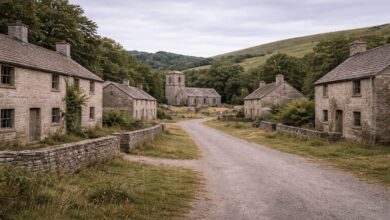
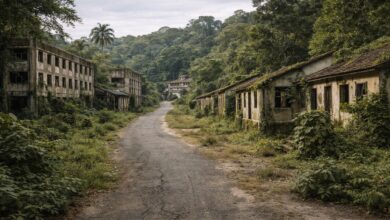
Bhangarh Fort is a historic fortified settlement located in the Aravalli Hills of northern India, positioned between the cities of Jaipur and Alwar. Established as a royal stronghold, the site once functioned as a planned urban and defensive complex, with palaces, temples, marketplaces, and enclosing walls reflecting its former political and administrative role.
Over time, Bhangarh declined through gradual abandonment rather than sudden destruction. Its population dispersed across generations as economic, political, and environmental conditions shifted. What remains today is a largely intact structure without a resident community, a condition that has shaped how the fort is perceived and regulated rather than defining its historical cause.
A planned city within stone walls
Bhangarh was founded in the late sixteenth century as a fortified settlement rather than a solitary military outpost. It included palaces, temples, markets, and residential quarters, all enclosed by strong defensive walls. The layout reflects careful planning, designed to support both governance and daily life. For a broader context, see Isla de las Muñecas.
At its height, Bhangarh functioned as a small city. Trade routes passed nearby. Religious life was active. The surrounding region supported agriculture and movement through the Aravalli corridor. Its position allowed oversight of surrounding valleys while remaining connected to larger political centers.
This was not a remote fortress built for isolation. It was a living settlement.
Royal patronage and regional power
The fort is traditionally associated with the Kachwaha Rajput rulers, who controlled much of the region during this period. Bhangarh served as a secondary seat of authority, supporting regional administration rather than imperial ambition.
Architectural elements reflect this status. The royal palace is substantial but restrained. Temples are prominent, indicating the importance of ritual life alongside governance. Residential structures suggest long term habitation rather than temporary garrison use.
These features indicate continuity rather than crisis. For many decades, Bhangarh operated as intended.
Gradual decline rather than collapse
Historical records suggest that Bhangarh was not destroyed by invasion or disaster. Instead, it experienced a slow decline influenced by political shifts, economic changes, and environmental pressures.
As regional power centers moved and trade routes evolved, Bhangarh lost strategic importance. Water availability became less reliable. Maintaining a fortified settlement without strong economic incentive grew increasingly difficult.
Over time, residents relocated to more favorable areas. Buildings fell into disuse. The fort was not abandoned in a single moment, but emptied gradually, generation by generation.
This pattern distinguishes Bhangarh from many other ruined sites. Its silence is cumulative, not abrupt.
The role of restriction
In modern times, Bhangarh is subject to official regulations that prohibit entry after sunset and before sunrise. These restrictions are often misunderstood or exaggerated, but their origin lies in conservation and safety rather than superstition.
The ruins are structurally fragile. Wildlife moves freely through the area at night. Limited lighting and uneven terrain pose real risks. Formal restrictions help preserve the site and prevent accidents.
However, these rules have contributed to public perception. Restriction invites speculation. Absence of access becomes interpreted as secrecy.
Folklore and layered narrative
Over centuries, local folklore developed around Bhangarh. Stories vary widely and often contradict one another. Some involve curses. Others speak of forbidden acts or moral warnings. These narratives are not supported by historical evidence, but they persist through repetition.
Such folklore is common around abandoned places. When written records thin, oral tradition fills the gap. Stories serve as explanations when practical reasons are no longer visible.
In Bhangarh’s case, folklore overlays history rather than replacing it. The fort’s real story is not erased. It is simply joined by interpretation.
Architecture without function
Walking through Bhangarh today, visitors encounter intact gates, crumbling residences, temple foundations, and palace remains. The structures are recognizable but inactive.
This lack of function creates dissonance. Buildings designed for movement and occupation now frame emptiness. Courtyards no longer gather people. Markets no longer exchange goods.
The fort has not been reconstructed into a curated experience. Its decay remains visible and uneven. This rawness contributes to its emotional impact.
Environment and atmosphere
The Aravalli landscape surrounding Bhangarh plays a critical role in how the site is experienced. The hills absorb sound. Vegetation grows into stonework. Wind moves freely through broken corridors.
As daylight fades, shadows lengthen across pathways once used daily. The fort feels more exposed than enclosed, its walls no longer defensive but observational.
This environment shapes perception. Stillness becomes noticeable. Distance feels amplified. The site encourages attention rather than movement.
Misinterpretation of silence
Silence is often mistaken for threat. In Bhangarh, silence results from absence, not hostility. There are no inhabitants to generate noise. No daily rituals to mark time.
Yet human psychology tends to fill silence with meaning. When places stop responding, they feel watchful. When stories circulate, expectation heightens sensation.
Bhangarh’s reputation grows not from events, but from anticipation.
Preservation without reinvention
Unlike many historic sites, Bhangarh has not been extensively commercialized. There are no large scale restorations designed to revive activity. This restraint preserves authenticity, but also leaves questions unanswered.
The fort remains a place to observe rather than consume. Visitors must supply context through learning rather than experience design.
This approach aligns with modern conservation principles that prioritize integrity over attraction.
Why Bhangarh endures
Bhangarh endures because it represents an unresolved ending. It was not destroyed. It was not transformed. It was simply left behind.
Such endings are rare. Most places are either rebuilt or erased. Bhangarh remains in between.
Its endurance reflects how societies change direction without ceremony. How communities relocate without memorial. How history sometimes fades quietly rather than concluding dramatically.
A site shaped by retreat
Ultimately, Bhangarh Fort is not defined by fear or legend. It is defined by retreat. By the slow withdrawal of people from a place that no longer served their needs.
The fort stands as a record of that process. Stone remembers even when people leave.
Its proximity to modern roads and cities makes this contrast sharper. Life continues nearby, yet the fort remains untouched. This topic is examined in depth in Poveglia Island.
Bhangarh is not waiting to be reactivated. It is waiting to be understood.
Between history and imagination
Bhangarh occupies a rare position where documented history and popular imagination coexist without resolution. Neither fully replaces the other.
This balance keeps the site alive in public memory. Not because it threatens, but because it withholds closure.
The fort does not explain itself. It invites careful interpretation.
In that invitation lies its enduring presence. A place shaped by absence, surrounded by stories, and preserved by restraint, Bhangarh Fort remains one of India’s most compelling examples of how history lingers when it is neither concluded nor erased.
Horizon Report documents places shaped by memory, infrastructure, and human decisions. Our editorial approach focuses on what remains physically visible, how abandonment unfolds over time, and how interpretation is clearly separated from observable evidence.
For readers seeking deeper context, the following background articles explore how ghost towns emerge, why communities are left behind, and why preservation matters in understanding collective history.
- Abandonment And Ghost Towns
- What Is A Ghost Town
- Why Towns Are Abandoned
- Preserving Abandoned Places
Editorial transparency matters. Observations are grounded in site layout, materials, remaining structures, and documented timelines where available. Interpretive layers are presented as interpretation, not assertion.
Careful readers often notice details worth refining. Thoughtful feedback helps ensure accuracy, clarity, and long term editorial integrity.