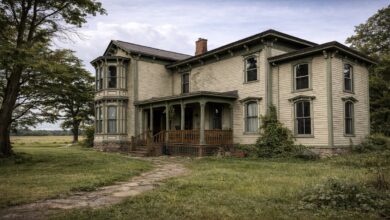
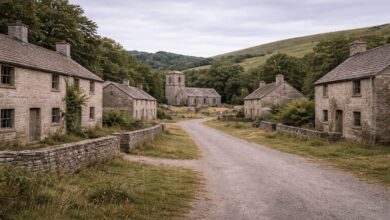
Houska Castle is a medieval stone fortress located in a forested region of the northern Czech Republic. Constructed in the late thirteenth century, it follows the basic architectural form of Central European castles, with enclosing walls, towers, a courtyard, and a chapel. At a structural level, it appears consistent with defensive and residential buildings of its period.
What distinguishes Houska Castle is not its form, but its placement. It stands far from major trade routes, borders, and population centres, overlooking no strategic valley and guarding no obvious approach. This absence of clear military or economic function places the castle outside conventional explanations and has shaped how it has been perceived across centuries.
A castle without a battlefield
Medieval castles were typically built with clear intent. They controlled roads, protected borders, asserted power over surrounding land, or safeguarded valuable resources. Houska does none of these things. It sits in a wooded area that, even in the Middle Ages, offered limited economic or military value.
There is no nearby river to control trade. No town grew around it to benefit from protection. The surrounding terrain does not funnel movement. From a defensive perspective, the site makes little sense.
This absence of strategic logic is one of the most striking aspects of Houska. It suggests that the castle was built for reasons that were not primarily military, or that those reasons have been lost to time. Similar human responses to silence and environment appear in Bhangarh Fort.
Construction and early history
Houska Castle is believed to have been constructed in the late thirteenth century, during the reign of Ottokar II of Bohemia. This period saw significant castle building across the region, often tied to consolidation of royal authority.
Records from the castle’s earliest years are sparse. Unlike prominent fortresses that appear frequently in administrative documents, Houska enters the historical record only intermittently. This lack of documentation does not imply secrecy, but it does leave questions unanswered.
What is clear is that the castle was completed with considerable investment. The stonework is substantial. The chapel is unusually prominent. These features suggest intention rather than improvisation.
Architectural irregularities
Houska’s internal layout raises as many questions as its location. Some windows appear decorative rather than functional, opening onto walls or enclosed spaces. Certain rooms lack clear residential purpose. Defensive features are present, but not optimized.
The chapel, positioned over a deep vertical cavity in the rock beneath the castle, is particularly notable. Rather than being oriented toward the landscape or community, it is inward facing, emphasizing containment rather than outreach.
From an architectural standpoint, this inward focus is unusual. Medieval castles were outward looking structures, projecting power and surveillance. Houska turns attention toward its own interior.
The central void
Beneath the castle lies a natural fissure or shaft in the bedrock. Geological studies suggest it is a vertical cavity formed through natural processes. During construction, this opening was incorporated rather than avoided.
The decision to build directly over this feature has fueled centuries of speculation. In practical terms, it may have been a challenge to build around, and enclosing it could have been the safest option. Yet the prominence given to the chapel above it suggests symbolic importance.
Rather than sealing the cavity and ignoring it, the builders marked it. This choice implies meaning, even if that meaning is no longer documented.
Folklore and later interpretation
As centuries passed and written records thinned, folklore filled the gaps. Local stories began to frame the castle as a place built to contain something rather than defend against something. These narratives vary widely and often contradict one another.
What they share is a focus on purpose. Why here. Why this design. Why so much stone for so little strategic return.
It is important to distinguish folklore from history. There is no evidence that Houska was intended for supernatural containment or ritual activity. However, the persistence of such stories reflects a genuine anomaly that invites interpretation.
A place of retreat rather than rule
One plausible explanation for Houska’s design is that it functioned as a royal retreat or administrative outpost rather than a fortress. Its isolation would have offered privacy. Its solid construction would have ensured safety without the need for constant garrisoning.
In this interpretation, the castle’s inward focus makes sense. It was not meant to oversee territory, but to exist apart from it. The surrounding forest would have provided separation rather than exposure.
Even so, this does not fully account for the scale of construction or the architectural emphasis on the central cavity.
Later uses and decline
Over the centuries, Houska Castle changed hands multiple times. It was used intermittently as a residence, storage site, and estate center. None of these roles fully utilized its original form.
During periods of conflict, the castle did not play a major defensive role. It was neither besieged extensively nor upgraded significantly for warfare. This relative quiet further distances it from typical castle narratives.
By the modern era, Houska had become a historical curiosity rather than a functional structure. Restoration efforts have focused on preservation rather than reinvention.
Silence and perception
Today, visitors often remark on the castle’s atmosphere. The surrounding forest dampens sound. The walls absorb light. Movement feels contained.
These sensory conditions contribute to Houska’s reputation. In places where stimulation is reduced, awareness increases. Silence becomes noticeable. Space feels deliberate.
Such effects do not require extraordinary causes. They arise naturally from design, materials, and environment. Yet when combined with historical uncertainty, they take on symbolic weight.
Why purpose matters
Humans are unsettled by structures that resist explanation. We expect buildings to justify themselves through function. When they do not, we search for alternative narratives.
Houska Castle challenges this expectation. Its purpose is not obvious. Its history is incomplete. Its design points inward rather than outward.
This combination creates cognitive tension. The castle feels intentional, but the intention is unclear.
Preservation without answers
Modern preservation has kept Houska largely intact, but it has not resolved its questions. There are no definitive discoveries that explain its origin fully. No document has emerged to clarify the reasoning behind its placement.
As a result, the castle remains open to interpretation. Not as a puzzle to be solved, but as a structure that demonstrates the limits of historical certainty.
Between function and meaning
Houska Castle endures because it sits between categories. It is not purely defensive, nor purely residential. It is not fully explained by politics, nor by geography.
Its meaning emerges from absence rather than presence. From what is missing rather than what is known.
In this way, Houska reflects a broader truth about history. Not all decisions are preserved. Not all purposes are recorded. Some structures outlast their explanations.
A place that resists closure
Ultimately, Houska Castle is compelling because it refuses to resolve into a single story. It does not confirm legend, nor does it dismiss curiosity.
It stands as a reminder that history is not always complete. That architecture can survive longer than intent. And that some places continue to ask questions long after those who built them are gone.
Houska Castle remains not as a warning or a spectacle, but as a quiet example of how meaning accumulates when function fades. Its walls still stand, its forest still surrounds it, and its purpose remains open, not to fear, but to careful consideration. Related reflections on memory and perception can also be found in Stirling Castle.
Horizon Report documents places shaped by memory, infrastructure, and human decisions. Our editorial approach focuses on what remains physically visible, how abandonment unfolds over time, and how interpretation is clearly separated from observable evidence.
For readers seeking deeper context, the following background articles explore how ghost towns emerge, why communities are left behind, and why preservation matters in understanding collective history.
- Abandonment And Ghost Towns
- What Is A Ghost Town
- Why Towns Are Abandoned
- Preserving Abandoned Places
Editorial transparency matters. Observations are grounded in site layout, materials, remaining structures, and documented timelines where available. Interpretive layers are presented as interpretation, not assertion.
Careful readers often notice details worth refining. Thoughtful feedback helps ensure accuracy, clarity, and long term editorial integrity.