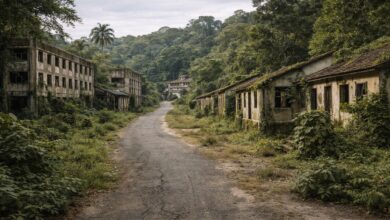
Along the northern coastline of New Taipei City, near the district of Sanzhi, once stood a cluster of brightly colored, circular concrete dwellings unlike anything else in East Asia. Officially known as the San Zhi Pod Houses, they became globally famous under a more informal name: the UFO Houses. Their curved forms, round windows, and elevated bases suggested a vision of the future that never arrived.
The San Zhi Houses were not abandoned ancient ruins or decaying industrial sites. They were modern structures, planned with optimism and commercial ambition. Their haunting reputation emerged not from age or tragedy alone, but from incompletion. They represent a moment when futuristic design collided with economic reality, leaving behind a landscape that felt out of time and unresolved.
A vision of modern living
The San Zhi Houses were conceived in the late 1970s as part of a luxury seaside development. Taiwan was experiencing rapid economic growth, and developers envisioned a holiday resort and residential complex aimed at affluent buyers, including military officers and international investors.
The pod like homes were inspired by contemporary ideas about modular living and space age aesthetics. Circular shapes were believed to be efficient, modern, and symbolic of progress. Elevated foundations were designed to protect against coastal humidity and flooding.
In concept, the project aligned with global architectural trends that embraced futurism and experimentation. It was not meant to be strange. It was meant to be aspirational. Similar human responses to silence and environment appear in Pripyat.
Architecture ahead of acceptance
Each pod was constructed from reinforced concrete, molded into rounded forms with large circular windows. Interiors were compact but functional, designed to maximize light and airflow. The houses were arranged in clusters, creating a visual rhythm that contrasted sharply with the surrounding natural landscape.
Despite their bold design, the houses struggled to gain acceptance. Many potential buyers found the architecture too unconventional. Practical concerns about maintenance, resale value, and long term livability surfaced early.
What looked visionary on paper proved difficult to market in reality.
Construction setbacks and financial strain
As development progressed, the project encountered significant delays. Costs rose. Investment slowed. Infrastructure supporting the complex, including roads and utilities, lagged behind schedule.
At the same time, Taiwan’s real estate priorities shifted. Demand favored more traditional housing styles. The San Zhi project lost momentum, and construction was eventually halted before completion.
Most of the houses were never occupied. Utilities were never fully connected. The future promised by the design stopped mid sentence.
Stories that filled the silence
Once abandoned, the site quickly attracted speculation. Local rumors circulated about accidents during construction. Some claimed that workers had died, and that the project was cursed. Others linked the site to broader anxieties about rapid modernization and foreign influence.
These stories were not supported by official records. However, in the absence of clear explanation, narrative filled the gap. The unusual shapes of the houses amplified unease. What was meant to symbolize the future began to feel disconnected from time altogether.
The haunting reputation of the San Zhi Houses was born not from documented events, but from cultural projection.
Environment and atmosphere
Situated between mountains and sea, the abandoned pods weathered quickly. Salt air corroded exposed metal. Paint faded. Vegetation grew around and through unfinished structures.
The curved architecture affected sound and light in unexpected ways. Wind moved differently through circular openings. Shadows bent around rounded walls. These sensory distortions reinforced the site’s unsettling reputation.
Yet the atmosphere was not threatening. It was suspended. The houses felt paused, as if waiting for residents who would never arrive.
Modern ruin without history
Unlike ancient ruins shaped by centuries, the San Zhi Houses became ruins almost immediately. Their decay was rapid and visible. This compressed timeline challenged expectations about permanence and progress.
The site became a symbol of failed futurism. A reminder that visions of tomorrow can age faster than the past.
Photographers, urban explorers, and curious visitors were drawn to the contrast between intention and outcome. The houses looked new and obsolete at the same time.
Demolition and erasure
In the late 2000s, authorities decided to demolish the San Zhi Houses. Safety concerns, land value, and development priorities outweighed preservation. By 2010, the pods were gone.
The demolition ended the physical presence of the site, but not its cultural impact. Images of the houses continue to circulate globally, often detached from context.
What remains today is largely empty land, repurposed and reshaped. The future imagined there has been erased, replaced by practical redevelopment.
Why the San Zhi Houses endure in memory
The San Zhi Houses endure because they represent a rare intersection of optimism and failure. They were not abandoned due to war, disaster, or ancient decline. They failed quietly, within a modern economic system.
Their story resonates because it reflects broader anxieties about progress. What happens when innovation moves faster than society’s willingness to adapt.
The haunting quality often attributed to the site stems from this disconnect. A future that arrived too early, then vanished.
Cultural interpretation rather than mystery
Despite sensational portrayals, the San Zhi Houses do not require supernatural explanation. Their story is grounded in economics, design, and cultural reception.
They became unsettling because they contradicted expectations. Modern structures are assumed to be purposeful. When they are not, discomfort follows.
The pods challenge the assumption that new always replaces old successfully.
A lesson in architectural ambition
The San Zhi Houses illustrate the risks of experimental design when divorced from social context. Architecture does not exist in isolation. It must be inhabited, maintained, and accepted.
Without those elements, even the most striking structures become shells.
The project’s failure does not negate its creativity. It highlights the importance of alignment between vision and lived reality.
Absence after demolition
Today, nothing remains of the pods themselves. Yet the idea of the San Zhi Houses persists, preserved through photographs and collective memory.
This absence adds another layer to their story. The houses are now doubly incomplete. First abandoned, then removed.
They exist only as reference, not as place.
An unfinished chapter of modernity
Ultimately, the San Zhi Houses stand as a reminder that modernity leaves ruins too. Not all ruins are ancient. Some are recent, shaped by ambition rather than erosion.
Their story is not one of fear, but of interruption. A future imagined, constructed, and then abandoned before it could begin.
The San Zhi Houses remain a quiet marker of how progress can falter, leaving behind not ghosts, but questions about how societies choose which futures to build and which to abandon. Related reflections on memory and perception can also be found in Göbekli Tepe.
Horizon Report documents places shaped by memory, infrastructure, and human decisions. Our editorial approach focuses on what remains physically visible, how abandonment unfolds over time, and how interpretation is clearly separated from observable evidence.
For readers seeking deeper context, the following background articles explore how ghost towns emerge, why communities are left behind, and why preservation matters in understanding collective history.
- Abandonment And Ghost Towns
- What Is A Ghost Town
- Why Towns Are Abandoned
- Preserving Abandoned Places
Editorial transparency matters. Observations are grounded in site layout, materials, remaining structures, and documented timelines where available. Interpretive layers are presented as interpretation, not assertion.
Careful readers often notice details worth refining. Thoughtful feedback helps ensure accuracy, clarity, and long term editorial integrity.