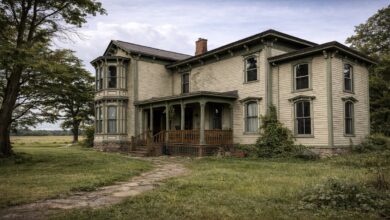
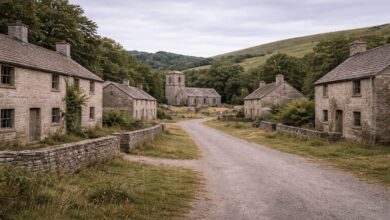
In the coal regions of eastern Pennsylvania, the town of Centralia stands as one of the most unusual settlements in the United States. What was once a typical mining community became something else entirely after an underground coal fire ignited in the early 1960s. The fire has never been fully extinguished. Instead, it continues to burn slowly beneath the ground, reshaping the landscape, the infrastructure, and the fate of the town above it.
Centralia is often described as eerie or abandoned, but its reality is more precise and more complex. It is not a ruin frozen by sudden disaster. It is a place altered gradually by a long term environmental event, where ordinary life gave way step by step to evacuation, uncertainty, and near emptiness. The town did not vanish. It thinned.
A town built on coal
Centralia was founded in the mid nineteenth century as a coal mining town. Anthracite coal fueled homes, factories, and railroads across the northeastern United States, and Centralia grew alongside this demand. Streets, churches, schools, and businesses followed the seams underground.
For generations, coal defined daily life. Mines provided employment. Rail lines moved resources outward. The town functioned like many others in the region, shaped by labor, routine, and community ties.
Importantly, Centralia was not isolated. It was part of a broader industrial network that depended on what lay beneath its surface. Similar human responses to silence and environment appear in The Winchester Mystery House.
The fire begins
In 1962, a fire was ignited in or near an old mine pit on the outskirts of town, reportedly during a cleanup effort. What appeared at first to be a manageable surface fire spread into abandoned underground coal seams.
Once underground, the fire found abundant fuel. Coal seams extend for miles beneath Centralia and surrounding areas. The fire moved slowly, feeding itself, insulated by earth and rock.
Early attempts to extinguish it failed. The complexity of underground tunnels, limited technology, and cost constraints made containment increasingly difficult.
A problem without a clear solution
As the fire continued, it became clear that it would not be easily stopped. Various proposals were considered, including excavation, isolation trenches, and flooding. All were expensive and uncertain.
At the same time, the fire was not immediately catastrophic. It advanced gradually. For years, daily life continued with limited disruption.
This slow progression delayed decisive action. Centralia existed in a prolonged state of assessment rather than emergency.
Environmental and structural effects
Over time, the effects of the underground fire became visible. Ground temperatures increased. Steam and smoke vented through cracks in the earth. Toxic gases such as carbon monoxide accumulated in low lying areas.
In some locations, the ground subsided as coal burned away beneath it. Roads buckled. Foundations weakened. Vegetation withered where heat escaped to the surface.
The most visible symbol of Centralia’s transformation became a section of cracked highway, warped by subsidence and venting heat. It illustrated how infrastructure designed for stability was undermined from below.
Gradual evacuation
As risks increased, authorities began relocating residents. In the 1980s and 1990s, government programs offered compensation and assistance for homeowners willing to leave.
This process was gradual and uneven. Some residents left quickly. Others resisted, unwilling to abandon homes, memories, and community.
There was no single evacuation moment. Instead, Centralia slowly emptied as houses were purchased and demolished. Streets grew quieter. Services closed.
What remained was not abandonment, but persistence by a few.
A town without a future plan
Unlike disaster zones rebuilt elsewhere, Centralia was deemed unsafe for long term habitation. In the 1990s, postal authorities revoked the town’s ZIP code. Municipal services were withdrawn.
Yet the land was not fenced off entirely. Cemeteries remained active. A handful of residents were allowed to stay under legal agreements acknowledging the risks.
Centralia became a place without a conventional future, maintained only to prevent immediate hazard rather than support growth.
Life amid anomaly
For those who remained, life continued under unusual conditions. Streets led to empty lots where houses once stood. Familiar landmarks disappeared.
The town’s geography shifted as demolition erased structures but left sidewalks and curbs behind. Trees reclaimed former neighborhoods. Wildlife moved freely.
Centralia did not collapse into ruin. It dissolved.
Media attention and misunderstanding
As Centralia’s population dwindled, it attracted outside attention. Images of smoke rising from the ground and cracked roads circulated widely. Some portrayals framed the town as apocalyptic or haunted.
These narratives often overlooked the lived experience of residents and the technical nature of the problem. Centralia is not mysterious. Its condition is documented and studied.
The fire is not symbolic. It is physical.
A long burning timeline
Experts estimate that the Centralia coal fire could continue for decades or even centuries. Underground coal fires are notoriously difficult to extinguish once established.
The fire moves unpredictably, influenced by geology, airflow, and available fuel. It may change direction, intensify, or diminish over time.
This uncertainty reinforces Centralia’s status as an anomaly. It exists in a prolonged present shaped by an ongoing process rather than a concluded event.
The landscape above and below
Centralia illustrates the relationship between surface life and subsurface reality. The town was built atop a resource that sustained it, and that same resource ultimately destabilized it.
This inversion challenges assumptions about control and permanence. What supported development became its undoing.
The fire beneath Centralia is invisible most of the time, yet its effects are unavoidable. It reshaped land use, infrastructure, and social fabric.
Why Centralia endures in public memory
Centralia endures because it demonstrates how slow disasters unfold. Unlike floods or earthquakes, underground fires do not announce themselves dramatically.
They persist quietly, forcing difficult decisions over long periods. This makes their impact harder to address and easier to delay.
Centralia is a case study in how incremental risk can hollow out a community.
Not a ghost town in the usual sense
Centralia is often labeled a ghost town, but this term oversimplifies reality. Ghost towns are typically abandoned due to economic shifts. Centralia was abandoned due to safety.
Its emptiness is not romantic. It is practical.
The town was not forgotten. It was intentionally reduced.
Lessons written in ground and time
Centralia offers lessons about resource extraction, long term environmental impact, and the challenges of remediation. It highlights the difficulty of reversing damage once certain thresholds are crossed.
It also reveals the human cost of gradual displacement. Communities do not vanish cleanly. They thin, fragment, and linger.
A place still changing
Even now, Centralia continues to change. Vegetation grows where streets once ran. Heat vents shift location. The map is not fixed.
The town exists as a moving condition rather than a stable place.
Between presence and absence
Standing in Centralia today, one encounters quiet rather than fear. The absence of houses does not erase the imprint of settlement. Curbs, road lines, and foundations remain as traces.
The fire below continues its slow work, unseen but decisive.
Centralia is not defined by what it looks like, but by what is happening beneath it.
A living anomaly
Ultimately, Centralia stands as a reminder that environmental processes can outlast human planning. The town did not fail socially or economically. It was overtaken geologically.
Its story is not a warning wrapped in myth. It is a documented example of how long term environmental forces reshape human geography.
Centralia remains, not as a destination, but as a condition. A near empty town shaped by a fire that never fully emerges, yet never fully ends. Related reflections on memory and perception can also be found in Dhanushkodi.
Horizon Report documents places shaped by memory, infrastructure, and human decisions. Our editorial approach focuses on what remains physically visible, how abandonment unfolds over time, and how interpretation is clearly separated from observable evidence.
For readers seeking deeper context, the following background articles explore how ghost towns emerge, why communities are left behind, and why preservation matters in understanding collective history.
- Abandonment And Ghost Towns
- What Is A Ghost Town
- Why Towns Are Abandoned
- Preserving Abandoned Places
Editorial transparency matters. Observations are grounded in site layout, materials, remaining structures, and documented timelines where available. Interpretive layers are presented as interpretation, not assertion.
Careful readers often notice details worth refining. Thoughtful feedback helps ensure accuracy, clarity, and long term editorial integrity.