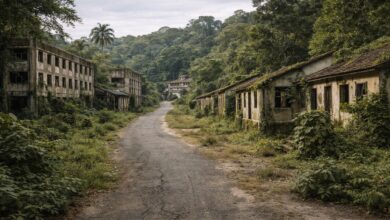
In the heart of Philadelphia, the massive stone walls of Eastern State Penitentiary enclose a space unlike any other in the history of incarceration. When it opened in 1829, the prison embodied a radical idea: that complete isolation would lead to reflection, repentance, and moral reform. Instead, the experiment reshaped prison design worldwide and left a legacy defined as much by human experience as by crumbling architecture.
Today, Eastern State Penitentiary is no longer an active prison, yet its reputation continues to grow. Often described as haunted, the site’s identity emerges not from unverifiable claims but from documented inmate experiences, psychological strain, and the physical atmosphere created by decay. Its story is grounded in history, intention, and consequence.
A revolutionary concept in punishment
Eastern State Penitentiary was founded during a period of reformist optimism in the United States. Influenced by Enlightenment thinking and Quaker principles, its creators believed that crime resulted from moral failure rather than inherent evil.
The solution they proposed was solitude. Prisoners would be isolated in individual cells, cut off from contact with other inmates. Silence and separation were meant to encourage self examination, remorse, and eventual rehabilitation. Similar human responses to silence and environment appear in Centralia.
This approach became known as the Pennsylvania System, and Eastern State was its most complete expression.
Architecture designed for isolation
The prison’s architecture was central to its philosophy. From a central rotunda, long cellblocks radiated outward like spokes of a wheel. This design allowed guards to observe corridors while minimizing inmate interaction.
Each cell was intended to be self contained. Prisoners ate, worked, slept, and exercised alone. Small private yards were attached to cells so inmates never encountered one another.
Even architecture enforced silence. Thick walls absorbed sound. Doors were designed to block voices. Hoods were reportedly used to prevent prisoners from seeing each other during transport.
The building itself became an instrument of discipline.
Daily life inside the cell
Life inside Eastern State was monotonous and confined. Prisoners spent nearly all hours alone. Labor was solitary, often involving repetitive crafts. Reading the Bible was encouraged. Conversation was forbidden.
For some, isolation led to reflection. For many others, it produced distress. Contemporary observers and later historians documented cases of anxiety, depression, hallucinations, and emotional breakdown.
The prison’s founders underestimated the psychological toll of prolonged solitude.
Early criticism and documented harm
By the mid nineteenth century, Eastern State’s methods attracted criticism. Visiting observers noted inmates displaying signs of mental deterioration. Charles Dickens, who toured the prison in 1842, described the system as cruel, citing its impact on the mind.
Medical professionals began to question whether isolation healed or harmed. Evidence increasingly suggested the latter.
Despite criticism, the model influenced prisons across the United States and Europe, embedding isolation deeply into modern penal systems.
Reform, adaptation, and overcrowding
As incarceration rates increased, Eastern State gradually abandoned strict solitary confinement. Cells designed for one prisoner began housing two or three. Silence rules loosened. Workshops and communal areas were introduced.
These changes altered the original philosophy but did not erase its legacy. The prison became overcrowded, conditions deteriorated, and the building aged under strain.
By the mid twentieth century, Eastern State no longer represented reform. It reflected the limitations of institutional control.
Closure and abandonment
Eastern State Penitentiary closed in 1971. Prisoners were transferred elsewhere, and the site was left largely untouched. Unlike facilities that were demolished or converted immediately, Eastern State entered a period of abandonment.
Roof sections collapsed. Paint peeled. Moisture damaged walls. Vegetation crept into corridors.
This slow decay preserved the prison’s atmosphere rather than erasing it.
Architecture as memory
What visitors encounter today is not a restored museum environment, but a stabilized ruin. Cracked walls, exposed brick, and filtered light define the experience.
The architecture itself tells the story. Long corridors emphasize distance. Narrow cells restrict movement. The scale of stone reinforces confinement.
This physical environment amplifies awareness of the past without requiring dramatization.
The emergence of a haunted identity
Eastern State’s reputation as haunted developed gradually. Former inmates described lingering fear, disorientation, and lasting psychological impact. Visitors reported strong emotional responses to the space.
These reactions are not surprising. Environments designed to isolate and control can provoke discomfort long after their original function ends.
The haunted identity emerges from empathy and atmosphere rather than unexplained events.
Sound, light, and perception
One reason Eastern State feels unsettling is sensory distortion. Sound echoes unpredictably. Light enters cells through narrow openings, creating sharp contrasts between brightness and shadow.
Human perception is sensitive to such conditions. Disorientation can occur even without conscious fear.
The building does not create experiences. It shapes them.
A site of reflection rather than spectacle
Unlike sensationalized portrayals, Eastern State today is interpreted through education and historical context. Exhibits focus on prison reform, mass incarceration, and the psychological impact of isolation.
The site encourages reflection rather than fear. Its power lies in realism.
The prison does not need embellishment to be effective.
Influence on modern incarceration
Eastern State’s legacy extends far beyond its walls. The use of solitary confinement remains a topic of intense debate in contemporary corrections.
Research continues to document the mental health risks associated with prolonged isolation. The prison stands as an early case study in unintended consequences.
Its history informs present discussions about punishment, rehabilitation, and human rights.
Why Eastern State endures
Eastern State endures because it represents an idea taken to its extreme. It shows what happens when architecture, ideology, and control align without sufficient understanding of human psychology.
The prison is a reminder that good intentions do not guarantee humane outcomes.
Its decaying walls make this lesson visible.
Between past and present
Walking through Eastern State today is not an encounter with mystery, but with continuity. The questions raised in the nineteenth century remain unresolved.
How should society respond to crime. What role should punishment play. Where is the line between discipline and harm.
The prison does not answer these questions. It frames them.
A place shaped by consequence
Eastern State Penitentiary is not haunted because of what might be there. It is compelling because of what was there.
Thousands of individuals lived within its walls under conditions that reshaped their minds. The building absorbed those experiences.
Decay did not erase meaning. It revealed it.
A monument to intention and impact
Ultimately, Eastern State Penitentiary stands as a monument not to cruelty, but to complexity. It was built to reform, not to torture. Its failure was not malice, but misunderstanding.
That distinction matters.
The prison’s haunted identity arises from this tension. Between care and control. Between hope and harm.
Architecture that remembers
Stone walls remember pressure. Narrow cells remember stillness. Corridors remember footsteps.
Eastern State remains because its architecture continues to communicate what words cannot fully capture.
It is a place where the design of isolation became a lived experiment, and where the consequences still echo in space. Related reflections on memory and perception can also be found in San Zhi Pod Houses.
Horizon Report documents places shaped by memory, infrastructure, and human decisions. Our editorial approach focuses on what remains physically visible, how abandonment unfolds over time, and how interpretation is clearly separated from observable evidence.
For readers seeking deeper context, the following background articles explore how ghost towns emerge, why communities are left behind, and why preservation matters in understanding collective history.
- Abandonment And Ghost Towns
- What Is A Ghost Town
- Why Towns Are Abandoned
- Preserving Abandoned Places
Editorial transparency matters. Observations are grounded in site layout, materials, remaining structures, and documented timelines where available. Interpretive layers are presented as interpretation, not assertion.
Careful readers often notice details worth refining. Thoughtful feedback helps ensure accuracy, clarity, and long term editorial integrity.