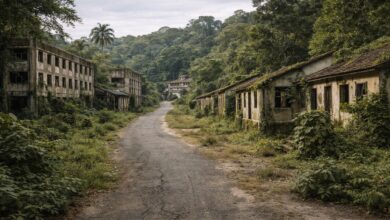
Southwest of Berlin, in the forests of Brandenburg, the vast grounds of Beelitz-Heilstätten extend across dozens of buildings linked by paths now softened by moss and roots. Once among Europe’s most advanced medical facilities, Beelitz-Heilstätten treated generations of patients, many of them soldiers wounded by war or suffering from tuberculosis. When medicine, politics, and population needs changed, the complex emptied gradually. Nature moved in where institutions withdrew.
Beelitz-Heilstätten is often described through an atmospheric lens, but its significance is grounded in function and history. It was not designed to intimidate or isolate. It was designed to heal. The quiet unease many feel today arises from contrast: a place built for care, now marked by absence and decay.
A purpose-built medical landscape
Construction of Beelitz-Heilstätten began in the late nineteenth century, during a period when tuberculosis posed a major public health challenge in Europe. Sanatoriums were built in rural settings, where fresh air, light, and isolation from urban pollution were believed to support recovery.
The Beelitz complex reflected this thinking. Buildings were spaced widely, oriented to maximize sunlight, and separated by gender and condition. Pavilions were connected by covered walkways, allowing patients to move outdoors while sheltered from weather. Similar human responses to silence and environment appear in Mount Shasta.
From the outset, Beelitz was conceived as a system rather than a single hospital.
Architecture designed for healing
Unlike fortress-like institutions, Beelitz-Heilstätten emphasized openness. Large windows, balconies, and terraces allowed patients to spend hours resting outdoors. Interiors were orderly and calm, prioritizing hygiene and routine.
Red brick façades, decorative details, and landscaped grounds conveyed dignity rather than severity. The environment was meant to reassure patients and staff alike.
This architectural language contrasts sharply with the way the site is sometimes perceived today.
Wartime use and transformation
During the First World War, Beelitz-Heilstätten was repurposed to treat wounded soldiers. Thousands passed through its wards, including young recruits suffering from battlefield injuries and trauma.
Medical care expanded beyond tuberculosis to address surgery, rehabilitation, and long-term recovery. The complex adapted to wartime needs without abandoning its core structure.
These years added a new layer to Beelitz’s identity. It became associated not only with illness, but with the physical cost of conflict.
Between wars and renewed purpose
After the war, the hospital returned to civilian use. Tuberculosis remained a concern, and Beelitz continued to operate as a sanatorium and medical center.
Medical practices evolved, but the campus structure remained effective. Its scale allowed specialization, while its setting supported rest and separation from urban pressures.
For decades, Beelitz functioned as intended. It was busy, structured, and maintained.
The Second World War and aftermath
The Second World War again altered Beelitz’s role. It treated injured soldiers and civilians during periods of intense strain. After the war, the complex fell within the Soviet occupation zone.
In the following decades, Soviet forces used Beelitz-Heilstätten as a military hospital. German civilians no longer accessed the site. While maintained for function, its original role as a public medical institution ended.
This period introduced separation. The complex became operational but closed to its surrounding community.
Withdrawal and vacancy
When Soviet forces withdrew in the early 1990s, Beelitz-Heilstätten was largely vacated. Medical operations ceased. Maintenance slowed. Some buildings were secured, others left exposed.
Unlike sudden abandonment caused by disaster, Beelitz’s decline was administrative. Funding ended. Purpose dissolved. Structures remained.
The complex did not collapse. It waited.
Nature reclaims space
Over time, vegetation spread across the grounds. Trees rooted near foundations. Ivy climbed façades. Paths cracked under leaf litter and soil.
This reclamation was gradual and uneven. Some buildings remained relatively intact. Others deteriorated quickly due to moisture, vandalism, and exposure.
Nature did not destroy Beelitz. It filled the gaps left by human absence.
Atmosphere shaped by contradiction
Visitors often describe Beelitz-Heilstätten as unsettling. This reaction is not caused by threat, but by contradiction. Medical spaces are associated with care, order, and presence. When emptied, they invert expectation.
Hospital rooms without patients feel unfinished. Corridors without staff feel unresolved. The architecture still suggests routine, but the routine is gone.
This dissonance produces discomfort.
Wartime memory and interpretation
Beelitz is sometimes framed primarily through its wartime associations. While war shaped its use, the site’s history is broader and more complex.
It represents long-term medical practice, evolving treatments, and changing social priorities. War intensified activity, but did not define the institution alone.
Reducing Beelitz to conflict overlooks its foundational purpose.
Preservation, access, and redevelopment
In recent years, parts of Beelitz-Heilstätten have been stabilized and repurposed. Some buildings are under restoration. Others remain closed due to safety concerns.
Public access is limited and structured. Walkways and guided routes allow observation without intrusion.
This approach reflects a balance between preservation and transformation. The site is neither fully restored nor left to disappear.
A case study in institutional withdrawal
Beelitz-Heilstätten illustrates how large institutions can outlast their function. Built for a specific medical philosophy, it became obsolete as treatments advanced and centralized hospitals replaced rural sanatoriums.
When function ended, scale became liability. Maintaining dozens of buildings without a unifying purpose proved impractical.
The complex transitioned from utility to artifact.
Why Beelitz-Heilstätten endures
Beelitz endures because it captures a moment when architecture, medicine, and environment aligned toward healing. Its abandonment highlights how quickly such alignments can dissolve.
The forested setting preserves the outline of intention. Buildings remain readable even as they decay.
This legibility keeps the story accessible.
Not a place of mystery, but memory
Despite sensational portrayals, Beelitz-Heilstätten does not require speculation to be compelling. Its history is documented. Its decline is understandable.
What lingers is memory. Of patients resting on balconies. Of soldiers recovering from injury. Of routines interrupted.
The site holds these traces without interpretation.
Between care and neglect
Beelitz-Heilstätten occupies a space between care and neglect. It was built to heal, then left without caretakers. This transition is not dramatic, but profound.
The absence of medical activity feels heavier precisely because care once filled the space.
Decay here does not signify failure. It signifies change.
A landscape shaped by withdrawal
Walking through Beelitz today reveals paths leading to empty wards, staircases ending in silence, windows framing trees where people once looked outward.
The forest does not erase these elements. It surrounds them.
This coexistence defines the site’s character.
A quiet legacy
Beelitz-Heilstätten stands as a reminder that institutions, even those devoted to healing, are temporary. Medicine evolves. Politics shift. Needs change.
What remains is architecture and memory.
The complex is not haunted by events beyond explanation. It is marked by use, strain, and abandonment.
Its quiet power lies in that honesty. Related reflections on memory and perception can also be found in Hashima Island.
Horizon Report documents places shaped by memory, infrastructure, and human decisions. Our editorial approach focuses on what remains physically visible, how abandonment unfolds over time, and how interpretation is clearly separated from observable evidence.
For readers seeking deeper context, the following background articles explore how ghost towns emerge, why communities are left behind, and why preservation matters in understanding collective history.
- Abandonment And Ghost Towns
- What Is A Ghost Town
- Why Towns Are Abandoned
- Preserving Abandoned Places
Editorial transparency matters. Observations are grounded in site layout, materials, remaining structures, and documented timelines where available. Interpretive layers are presented as interpretation, not assertion.
Careful readers often notice details worth refining. Thoughtful feedback helps ensure accuracy, clarity, and long term editorial integrity.