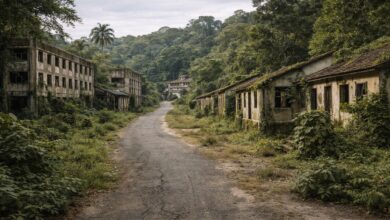
On the outskirts of Phnom Penh, beyond the traffic and daily movement of the modern city, lies Choeung Ek. Today, the site appears restrained and quiet. Paths cut through grass. Trees stand still. A memorial stupa rises at the center. Yet Choeung Ek is one of the most significant places of remembrance in Cambodia. During the late 1970s, it functioned as a mass execution site under the Khmer Rouge regime. Thousands were killed here. What remains now is not activity, but memory carefully held in place.
Choeung Ek is often described through emotional response. Visitors frequently speak of unease, heaviness, or silence that feels deliberate. These reactions are not mysterious. They emerge from the convergence of documented violence, minimal intervention, and the ethical weight of remembrance. Choeung Ek is not a place shaped by legend. It is shaped by record.
Historical context of the site
Between 1975 and 1979, Cambodia experienced one of the most devastating periods in its history. The Khmer Rouge regime pursued radical social engineering that resulted in mass imprisonment, forced labor, famine, and execution.
Choeung Ek was one of several execution sites connected to detention centers in Phnom Penh, including the former Tuol Sleng prison. Prisoners were transported to Choeung Ek to be killed and buried in mass graves. Similar human responses to silence and environment appear in Göbekli Tepe.
The site functioned systematically. It was not improvised. It was part of an organized process of elimination.
Geography and selection
Choeung Ek was chosen for its location. Far enough from the city to limit public awareness, yet close enough for transport. The area was semi rural, with soft ground suitable for burial.
Execution sites were selected pragmatically. Accessibility and concealment mattered more than symbolism.
The landscape did not acquire meaning until after the events occurred.
Method and routine
Historical documentation and survivor testimony describe how executions were carried out with efficiency and brutality. Victims were often killed without firearms to conserve ammunition. Sound was masked by noise from generators or music.
Children were not spared. Families were not separated. These facts are among the most difficult aspects of Choeung Ek’s history.
The scale of violence was immense, but it unfolded through repetition rather than spectacle.
Discovery after regime collapse
After the fall of the Khmer Rouge, mass graves were uncovered across Cambodia. At Choeung Ek, thousands of human remains were found, many still visible at the surface due to erosion.
The site became evidence. Bones, clothing fragments, and burial pits documented what had occurred.
Choeung Ek was not revealed through rumor. It was revealed through excavation.
Memorialization and restraint
Unlike sites reconstructed for narrative impact, Choeung Ek was preserved with restraint. A memorial stupa was constructed to house recovered skulls. The grounds were left largely unchanged.
Paths guide visitors through former burial areas. Signs identify pits, but do not dramatize.
This restraint is intentional. The site prioritizes remembrance over interpretation.
Silence as structure
Silence is one of Choeung Ek’s defining features. It is not enforced, but it emerges naturally. Visitors lower their voices. Movement slows.
This silence functions as a form of respect. It also reflects the absence left behind.
Silence here is not emptiness. It is acknowledgment.
Memory without spectacle
Choeung Ek does not rely on reenactment, sound effects, or visual reconstruction. The memorial does not simulate violence.
Instead, it presents evidence. The stupa displays skulls. The ground marks burial sites.
This approach places responsibility on the observer rather than the site.
Reported unease and perception
Many visitors report a sense of unease while walking the grounds. This reaction is frequently described as physical rather than visual.
Psychologically, such responses are consistent with known effects of sites associated with mass death. Awareness of what occurred alters perception of space.
Unease here is not inexplicable. It is contextual.
The role of expectation
Visitors arrive at Choeung Ek with prior knowledge. Names, numbers, and images are often already known.
Expectation shapes experience. When one knows the ground contains graves, movement becomes careful. Attention increases.
The site does not create fear. Knowledge does.
Nature and contrast
Over time, vegetation has returned to Choeung Ek. Trees grow. Grass covers soil. Birds move through the area.
This natural presence creates contrast rather than comfort. Life continues where mass death occurred.
This contrast can be emotionally disorienting.
Ethical boundaries of interpretation
Choeung Ek is not a place for speculation. Ethical interpretation requires restraint. The facts are sufficient.
Attempts to frame the site through supernatural language or sensationalism obscure its purpose.
The site exists to remember victims, not to entertain interpretation.
Education and responsibility
Choeung Ek functions as an educational site. It is visited by students, researchers, and international observers.
The information presented focuses on historical context, not narrative embellishment.
Education here is an act of prevention. Remembering aims to reduce repetition.
Collective memory and national trauma
For Cambodia, Choeung Ek is part of a broader landscape of trauma. Many families lost members. Many survivors remain.
The site contributes to collective memory, allowing grief to be acknowledged publicly.
Memory is not abstract here. It is geographic.
Why unease persists
Unease persists at Choeung Ek because the site resists normalization. It was not redeveloped. It was not erased.
The ground remains what it was. That continuity prevents emotional distance.
The site does not allow easy closure.
Absence as testimony
Choeung Ek testifies through absence. There are no voices, yet names remain. There is no activity, yet evidence persists.
This absence is not neglect. It is preservation.
The site speaks by not speaking.
Comparison with other memorials
Many memorials use symbolic architecture to convey loss. Choeung Ek relies on minimal intervention.
This difference shapes response. Symbol allows abstraction. Evidence does not.
Choeung Ek remains concrete.
A place that demands restraint
Visitors often leave Choeung Ek quietly. There is little desire to linger.
The site does not invite contemplation in the abstract. It invites recognition.
Restraint is the appropriate response.
Why Choeung Ek matters globally
Choeung Ek matters because it documents the consequences of ideology without accountability. It shows how ordinary landscapes can become instruments of mass violence.
Its preservation serves as warning rather than explanation.
The site does not ask why. It shows what happened.
Memory without resolution
There is no resolution at Choeung Ek. There is no conclusion that makes sense of loss.
The site exists to ensure the events are not forgotten, not to be explained away.
Memory here is ongoing.
A place defined by record
Choeung Ek is defined by documentation, not rumor. Survivor testimony, physical evidence, and historical record align.
Unease arises not from uncertainty, but from clarity.
The site is heavy because it is known.
Enduring Perspective
Choeung Ek stands as a site of mass execution where silence and memorization coexist. Its unease is not mysterious. It is ethical, historical, and human.
The ground holds record. The memorial holds remains. Visitors hold memory.
Choeung Ek does not seek interpretation beyond acknowledgment. It exists so that what occurred is neither denied nor abstracted. In that stillness, remembrance continues. Related reflections on memory and perception can also be found in Kowloon Walled City.
Horizon Report documents places shaped by memory, infrastructure, and human decisions. Our editorial approach focuses on what remains physically visible, how abandonment unfolds over time, and how interpretation is clearly separated from observable evidence.
For readers seeking deeper context, the following background articles explore how ghost towns emerge, why communities are left behind, and why preservation matters in understanding collective history.
- Abandonment And Ghost Towns
- What Is A Ghost Town
- Why Towns Are Abandoned
- Preserving Abandoned Places
Editorial transparency matters. Observations are grounded in site layout, materials, remaining structures, and documented timelines where available. Interpretive layers are presented as interpretation, not assertion.
Careful readers often notice details worth refining. Thoughtful feedback helps ensure accuracy, clarity, and long term editorial integrity.