On the slopes above the southern coast of Turkey, overlooking the fertile valley near Fethiye, lies Kayaköy. Thousands of stone houses climb the hillside in orderly rows, their walls intact, their roofs long gone. Streets still follow the logic of daily life, yet no doors open, no voices carry, and no routine returns. Kayaköy is not abandoned because of disaster or decay. It was emptied by policy.
The village stands as a physical consequence of forced population exchange, where history interrupted everyday life without destroying the structures that held it. Its atmosphere arises from alignment without activity, form without continuity, and memory fixed in stone.
A living village before displacement
Before the twentieth century, Kayaköy was a thriving Greek Orthodox settlement known as Levissi. Families lived in close proximity, farming the surrounding land and maintaining schools, churches, and communal institutions. Houses were built with care and repetition, aligned to capture light, air, and shared access.
The settlement was dense but organized. Each home reflected adaptation to terrain and climate, while remaining connected to its neighbors. Life unfolded vertically along the hillside, shaped by proximity and shared rhythm. Similar human responses to silence and environment appear in Ruins of Kuldhara.
Community was embedded in structure.
The population exchange that ended life in place
In the early 1920s, following war and political redefinition, Greece and Turkey enacted a compulsory population exchange based on religious identity. Greek Orthodox residents were forced to leave Anatolia, while Muslim populations from Greece were relocated to Turkey.
Kayaköy’s inhabitants departed under mandate, not choice. Homes were left intact, but ownership was severed.
Life was removed, not relocated within the same space.
Why the village was never resettled
After the exchange, efforts were made to resettle Kayaköy with incoming populations. These efforts largely failed. The terrain, agricultural patterns, and social structure did not align with new settlers’ needs.
Without a stable replacement community, the village slowly emptied again.
Architecture remained. Continuity did not.
Roofless houses and exposed interiors
One of Kayaköy’s most striking features is the absence of roofs. Over time, roofing materials were removed or collapsed, leaving open shells of stone.
Walls remain upright. Windows frame sky. Interiors are exposed to light and weather.
This openness transforms private domestic space into public ruin, intensifying the sense of absence.
Alignment without occupation
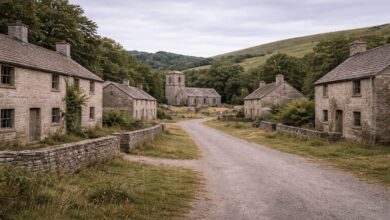
Kayaköy’s houses are carefully aligned along the slope. Streets follow predictable paths. The village still reads as organized and intentional.
This alignment suggests readiness for life. The absence of life contradicts that suggestion.
The resulting tension shapes visitor response.
Silence shaped by repetition
Thousands of nearly identical structures create visual repetition. Repetition without variation can feel overwhelming.
Without human activity to break pattern, silence becomes dominant. Sound dissipates quickly among stone walls.
The village feels paused mid sentence.
Unease rooted in historical clarity
Unease at Kayaköy does not arise from ambiguity. Its history is well documented. The cause of abandonment is known.
The discomfort stems from clarity. People know why life ended here, and that knowledge is embedded visibly in the landscape.
Understanding does not soften impact. It sharpens it.
Houses as containers of interrupted routine
Each house once held ordinary life. Cooking, sleeping, conversation, illness, celebration.
When thousands of such containers remain empty, the scale of interruption becomes tangible.
Kayaköy is not one abandoned home. It is an abandoned system of daily living.
Churches without congregations
Several churches remain standing within the village, stripped of function but not form. Their placement reflects former spiritual and social organization.
Religious buildings without congregations amplify absence. They suggest gathering where none occurs.
Silence here carries cultural weight.
Landscape as witness
Unlike villages reclaimed by forest, Kayaköy remains exposed. Grass and shrubs grow, but stone dominates.
The landscape does not conceal the settlement. It frames it.
Visibility prevents forgetting.
Comparison with other abandoned settlements
Many abandoned villages result from economic decline or environmental disaster. Kayaköy differs because departure was immediate and external.
The village did not fail internally. It was emptied from outside.
This distinction deepens its historical gravity.
Memory without return
Former residents did not return. Descendants remember the village through stories rather than place.
Kayaköy remains physically present but socially severed.
Memory exists without possibility of restoration.
Preservation and restraint
Kayaköy is protected as a heritage site. Restoration focuses on stabilization rather than reconstruction.
The goal is to preserve evidence, not revive function.
Preservation here means maintaining interruption.
Why stories of presence persist
Some visitors describe a sense of presence in Kayaköy. This presence is not defined by events or apparitions.
It reflects scale. Thousands of aligned homes imply thousands of lives.
The mind responds to magnitude.
Architecture as historical document
Kayaköy requires no plaque to explain its significance. The layout, density, and emptiness communicate history directly.
Architecture becomes archive.
Silence becomes testimony.
Ethical engagement with the site
Kayaköy demands respectful engagement. It represents forced migration and loss rather than mystery.
Sensational framing obscures human consequence.
The village is not a curiosity. It is evidence.
Time suspended rather than erased
Kayaköy does not feel ancient. It feels unfinished. Roofless walls still define rooms. Paths still guide movement.
The village resists closure.
Time appears suspended rather than past.
Enduring Perspective
Kayaköy endures as a Greek village abandoned through population exchange, where thousands of roofless houses remain aligned but lifeless. Its power lies in preservation without continuity, clarity without resolution.
The village does not rely on legend. Its history is sufficient. Forced departure ended daily life, yet left structure intact enough to remember it clearly.
On the hillside above Fethiye, Kayaköy stands as a visible pause in human settlement. It reminds us that abandonment does not always follow collapse. Sometimes it follows order, policy, and certainty, leaving behind places that remain complete in form, yet permanently empty of life. Related reflections on memory and perception can also be found in Harrisville House.
Horizon Report documents places shaped by memory, infrastructure, and human decisions. Our editorial approach focuses on what remains physically visible, how abandonment unfolds over time, and how interpretation is clearly separated from observable evidence.
For readers seeking deeper context, the following background articles explore how ghost towns emerge, why communities are left behind, and why preservation matters in understanding collective history.
- Abandonment And Ghost Towns
- What Is A Ghost Town
- Why Towns Are Abandoned
- Preserving Abandoned Places
Editorial transparency matters. Observations are grounded in site layout, materials, remaining structures, and documented timelines where available. Interpretive layers are presented as interpretation, not assertion.
Careful readers often notice details worth refining. Thoughtful feedback helps ensure accuracy, clarity, and long term editorial integrity.