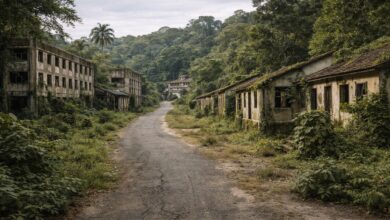
In the northern Adriatic Sea, between the Croatian mainland and neighboring islands, lies Goli Otok. From a distance, it appears stark and exposed, its rocky surface stripped of trees and softened only by low vegetation. Up close, the island reveals something more unsettling than emptiness alone. Roads, workshops, barracks, administrative buildings, and quarries remain in place, forming a complete settlement without inhabitants. Goli Otok was not abandoned through neglect or natural disaster. It was emptied after political change rendered its function obsolete.
What remains is an intact system without users. The island’s infrastructure persists, unused but legible, reinforcing a sense of suspended authority rather than decay.
An island chosen for isolation
Goli Otok was selected deliberately for its harsh geography. With little natural shelter, minimal shade, and strong seasonal winds, the island offered natural isolation. Access could be controlled easily. Escape was unlikely.
These qualities made it suitable for detention rather than habitation. From the beginning, the island’s relationship to human presence was conditional and imposed. Similar human responses to silence and environment appear in Bhangarh Fort.
Isolation was not a byproduct. It was the design principle.
Construction of a controlled settlement
Unlike makeshift camps, Goli Otok developed into a structured prison settlement. Buildings were erected for housing, administration, labor, and logistics. Roads connected zones. Quarries and workshops supported forced labor.
The layout reflects long term planning rather than temporary use. Everything necessary for containment and productivity existed on site.
The settlement functioned as a closed system.
Political context and function
Goli Otok operated during a period of intense political repression in the former Yugoslavia, primarily used for the imprisonment of political detainees. Inmates were subjected to forced labor, surveillance, and isolation.
The island’s role was specific and time bound. It existed to enforce ideological conformity through removal from society.
When political conditions changed, the prison’s purpose dissolved.
Closure without transformation
Unlike prisons converted into museums or repurposed facilities, Goli Otok was simply closed. Operations ceased. Personnel left. Inmates were transferred or released.
No replacement function followed. The infrastructure was neither demolished nor meaningfully adapted.
The island entered a state of functional abandonment.
Buildings without authority
Administrative offices, guard posts, dormitories, and work halls still stand. Doors hang open. Walls bear traces of use. Equipment and fixtures remain scattered.
These structures were built to exert control. Without authority present, they feel directionless.
Power remains implied, but inactive.
Roads that lead nowhere
Goli Otok’s internal road network still defines movement across the island. Paths link facilities logically. Vehicles could once circulate efficiently.
Today, these roads serve no transport need. They guide visitors through absence rather than activity.
Movement continues without purpose.
The quarry as central mechanism
Forced labor in the island’s quarries shaped daily life for detainees. Stone extraction was physically demanding and symbolically reinforcing. The island itself became both prison and workplace.
The quarries remain visible scars in the landscape. They are inseparable from the built environment.
Labor shaped the island as much as confinement.
Silence shaped by exposure
The island’s lack of trees and shelter amplifies sound. Wind dominates. Footsteps echo briefly and then vanish.
This acoustic openness contrasts with the density of buildings. Silence here feels imposed rather than natural.
The environment still enforces awareness.
Why unease is often reported
Visitors frequently describe unease on Goli Otok. This response is not rooted in uncertainty. The island’s history is documented.
Unease arises from structural clarity. The settlement was designed for control, and that design remains visible.
The body recognizes spaces meant to restrict.
Absence without erasure
Goli Otok differs from ruins reclaimed by nature. Vegetation has not overtaken buildings. Walls remain exposed. The settlement has not been softened.
Absence here is stark. Nothing conceals the function these structures once served.
Exposure sustains memory.
Infrastructure as evidence
Every remaining building functions as evidence rather than artifact. There is little interpretive framing on site.
The island explains itself through layout and scale.
Understanding comes from navigation rather than signage.
Comparison with other abandoned prisons
Many former prisons are absorbed into cities or recontextualized as heritage sites. Goli Otok remains geographically and socially isolated.
Its abandonment is total rather than partial.
The settlement exists without narrative mediation.
Ethical engagement and restraint
Goli Otok represents suffering enforced by political authority. Engagement with the site demands restraint.
Sensational framing risks trivializing lived experience. The island is not a backdrop. It is a record.
Respect requires clarity, not embellishment.
Time without reinvention
Time has altered surfaces but not meaning. Rust, erosion, and weathering occur slowly.
No new identity has replaced the old one.
The island remains what it was, minus people.
Presence defined by system
Reports of presence on Goli Otok often refer to the feeling of being observed or directed. These sensations reflect the spatial logic of surveillance.
Corridors align sightlines. Open yards lack shelter.
The system still organizes perception.
Political change without spatial resolution
The ideology that created Goli Otok dissolved, but the space it produced remains unresolved.
Physical structures did not transition alongside political structures.
This disconnect intensifies the island’s impact.
Why the island still matters
Goli Otok matters because it demonstrates how political systems leave physical residue. Even when authority withdraws, its architecture persists.
The island shows that infrastructure can outlast ideology.
What remains shapes memory.
Between abandonment and accountability
Goli Otok is not simply abandoned. It is unresolved. There has been no comprehensive effort to reinterpret or integrate it into public narrative.
The island sits between forgetting and acknowledgment.
This tension defines its atmosphere.
A settlement without future use
Unlike many abandoned places, Goli Otok does not invite reuse. Its design resists adaptation.
The infrastructure remains specific to its original purpose.
Specificity limits reinvention.
Enduring Perspective
Goli Otok endures as a former prison settlement abandoned after political change, where an entire infrastructure remains unused but intact. Its power lies in clarity rather than mystery. Roads, buildings, and quarries still articulate a system of control without occupants.
The island does not ask to be imagined differently. It stands as material evidence of how authority once organized space and bodies. When that authority vanished, it left behind a complete framework with no role.
In the Adriatic Sea, exposed to wind and time, Goli Otok remains a reminder that political systems may dissolve quickly, but the environments they create often persist, demanding recognition long after their purpose has ended. Related reflections on memory and perception can also be found in Ross Island.
Horizon Report documents places shaped by memory, infrastructure, and human decisions. Our editorial approach focuses on what remains physically visible, how abandonment unfolds over time, and how interpretation is clearly separated from observable evidence.
For readers seeking deeper context, the following background articles explore how ghost towns emerge, why communities are left behind, and why preservation matters in understanding collective history.
- Abandonment And Ghost Towns
- What Is A Ghost Town
- Why Towns Are Abandoned
- Preserving Abandoned Places
Editorial transparency matters. Observations are grounded in site layout, materials, remaining structures, and documented timelines where available. Interpretive layers are presented as interpretation, not assertion.
Careful readers often notice details worth refining. Thoughtful feedback helps ensure accuracy, clarity, and long term editorial integrity.