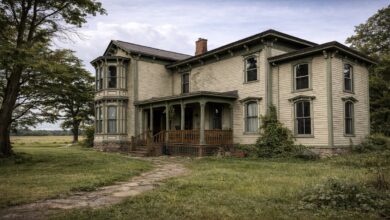
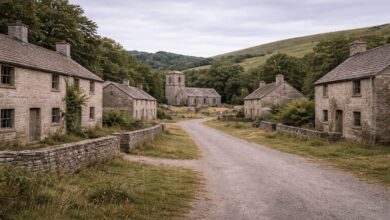
On the vast chalk expanse of Salisbury Plain in southern England, the village of Imber still stands largely intact, yet inaccessible for most of the year. Stone cottages line narrow lanes. A church rises at the center. Fields stretch outward exactly as they once did. Imber was not destroyed, nor did it decline naturally. It was evacuated under government order during wartime and never returned to civilian life.
What makes Imber distinctive is not ruin, but restraint. The village remains complete enough to be lived in, yet it is deliberately withheld from everyday use. Its identity is shaped by restriction rather than collapse.
A functioning rural village
Before evacuation, Imber was an ordinary agricultural community. Families lived in modest stone houses. Farming structured daily routines. The church functioned as a social and spiritual center.
The village was neither isolated nor failing. Its rhythms were stable and familiar, shaped by land use and seasonal labor. Similar human responses to silence and environment appear in abandoned village of Craco.
Imber existed to continue, not to end.
Wartime decision and forced evacuation
During the Second World War, the British government requisitioned large areas of Salisbury Plain for military training. Imber fell within this zone.
Residents were told the evacuation would be temporary. They were asked to leave with the expectation of return after the conflict ended.
That return never came.
From temporary measure to permanent exclusion
After the war, military use of the surrounding land expanded rather than contracted. Training requirements changed. Infrastructure adapted to defense needs.
Imber was absorbed into a permanently restricted zone. Civilian access became limited and controlled.
A temporary decision hardened into permanence.
A village maintained, not reused
Unlike many evacuated settlements, Imber was not dismantled. Buildings were maintained to a basic standard. Roads remained. The church was preserved.
The village was neither restored for new residents nor allowed to decay fully.
Maintenance without habitation created a rare condition: preservation without life.
Restricted access as defining feature
Imber is not forgotten. It is actively controlled. Access is permitted only on limited open days.
Fences, signs, and military presence define its perimeter. The village is visible but unavailable.
Restriction becomes the village’s primary characteristic.
Streets without routine
Walking through Imber during permitted access reveals a complete spatial logic. Streets lead to homes. Paths connect fields. The village still directs movement.
What is missing is repetition. No daily routines reinforce these paths.
The absence of repetition freezes time.
Houses built for return
Many of Imber’s houses remain structurally sound. They were not stripped or repurposed.
This condition reflects the original promise of return. Buildings were left as if occupation might resume.
Expectation was embedded in architecture.
The church as enduring center
The village church remains a focal point. It is occasionally used during access days, maintaining a fragment of original function.
Religious structures often persist longest because they carry symbolic continuity.
In Imber, the church reinforces the sense that life could restart, but does not.
Military presence without habitation
Although civilians do not live in Imber, the surrounding land is active. Military exercises occur nearby.
This juxtaposition is striking. Activity surrounds stillness. Movement encircles absence.
The village exists inside motion without participating in it.
Why unease is often reported
Visitors frequently describe unease at Imber. This reaction does not stem from mystery or legend.
It arises from contradiction. The village looks usable but is forbidden. It feels ready but inaccessible.
The mind registers exclusion more strongly than decay.
Absence enforced rather than natural
Most abandoned villages fade because people stop coming. Imber remains empty because people are not allowed.
This distinction matters. Absence here is maintained by authority.
Authority replaces time as the governing force.
Preservation without narrative closure
There has been no definitive moment marking Imber’s end as a living village. No ceremony, no destruction.
The lack of closure sustains uncertainty.
The village exists in a state of prolonged postponement.
Comparison with other evacuated settlements
Many wartime evacuations were reversed. Others ended in demolition or redevelopment.
Imber stands apart because neither occurred.
The village was paused, not concluded.
Ethical restraint and memory
Imber represents displacement under state authority rather than market forces or disaster.
Engagement with the site demands restraint. It is not a spectacle, but a consequence of policy.
The village asks to be observed, not consumed.
Time shaped by policy
Time in Imber does not progress organically. Buildings age slowly under maintenance. Use does not evolve.
Policy interrupts natural lifecycle.
As a result, the village resists historical categorization.
A living plan without life
Urban planners often speak of “living villages.” Imber is a planned village without living residents.
Its design still functions, but its purpose is suspended.
Function without users becomes uncanny.
Memory held in place
Former residents and descendants retain memory of Imber as a home rather than a site.
Because the village remains visible, memory stays anchored geographically.
This anchoring prevents abstraction.
Why Imber still matters
Imber matters because it demonstrates how easily continuity can be halted without physical destruction.
Life ended here not through failure, but through decision.
The village reveals the long tail of temporary measures.
Between safety and loss
The military use of the land was justified by national security. The cost was civilian displacement.
Imber embodies this tradeoff physically.
Its emptiness is not accidental.
A village defined by waiting
Imber does not feel past. It feels pending. Buildings stand as if waiting for occupants who were promised return.
Waiting becomes identity.
The village is defined by what did not happen.
Enduring Perspective
Imber endures as a village evacuated for military training and never reopened, where complete infrastructure remains frozen behind restricted access. Its power lies not in ruin, but in restraint. The village was not allowed to finish its story.
Stone houses still line the lanes. The church still marks the center. Fields still stretch outward. Everything needed for life remains, except permission.
On Salisbury Plain, Imber stands as a reminder that disappearance does not always require destruction. Sometimes it requires only a decision, repeated long enough that waiting becomes permanent. Related reflections on memory and perception can also be found in former town of Mologa.
Horizon Report documents places shaped by memory, infrastructure, and human decisions. Our editorial approach focuses on what remains physically visible, how abandonment unfolds over time, and how interpretation is clearly separated from observable evidence.
For readers seeking deeper context, the following background articles explore how ghost towns emerge, why communities are left behind, and why preservation matters in understanding collective history.
- Abandonment And Ghost Towns
- What Is A Ghost Town
- Why Towns Are Abandoned
- Preserving Abandoned Places
Editorial transparency matters. Observations are grounded in site layout, materials, remaining structures, and documented timelines where available. Interpretive layers are presented as interpretation, not assertion.
Careful readers often notice details worth refining. Thoughtful feedback helps ensure accuracy, clarity, and long term editorial integrity.