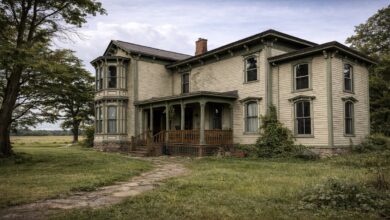
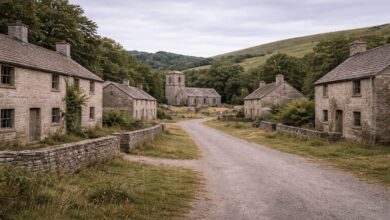
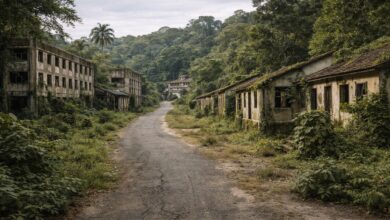
At the edge of Death Valley, in the arid expanse of Nevada, the remains of Rhyolite stand exposed to sun, wind, and time. Unlike many western ghost towns reduced to scattered wood and stone, Rhyolite retains large concrete structures that continue to define its streets. Banks, schools, and commercial buildings remain upright, stripped of function but not form. The town did not fade slowly into obscurity. It rose fast, collapsed hard, and was left to persist without restoration.
Rhyolite’s power lies in what remains unchanged. Its buildings were never rebuilt, never repurposed, and never softened into nostalgia. They endure as evidence of ambition that outpaced reality.
A town built on expectation
Rhyolite emerged in the early twentieth century after the discovery of gold in the surrounding Bullfrog Hills. News traveled quickly. Investors arrived with capital, and infrastructure followed with unusual speed.
Unlike temporary mining camps, Rhyolite was built to last. Concrete was chosen over wood. Brick and stone replaced canvas. Streets were laid out with permanence in mind. Similar human responses to silence and environment appear in remains of Calico Ghost Town.
The town was constructed as if success were guaranteed.
Rapid growth and civic confidence
Within a few years, Rhyolite developed banks, schools, hotels, utilities, and a stock exchange. Electricity and plumbing arrived early. The town promoted itself as a regional hub rather than a speculative outpost.
This confidence shaped its architecture. Buildings were large, formal, and civic in scale.
They assumed a future.
Collapse without catastrophe
Rhyolite’s decline did not come from disaster or violence. Gold production failed to meet expectations. Investment stalled. Financial panic elsewhere accelerated withdrawal.
Economic collapse emptied the town almost as quickly as it had filled it. Businesses closed. Families left. Services vanished.
The town lost purpose before it lost structure.
Concrete as unintended preservation
The use of concrete distinguished Rhyolite from many neighboring settlements. When residents left, buildings did not immediately decay.
Walls remained standing. Facades stayed legible. Interiors emptied, but shells endured.
Material choice preserved absence.
Streets that still read as streets
Walking through Rhyolite today, streets remain clearly defined. Intersections align. Building footprints still guide movement.
Urban logic persists even without activity.
This clarity intensifies the sense of interruption rather than erosion.
The Cook Bank as focal remnant
Among Rhyolite’s most prominent structures is the former bank building. Its walls still rise above the desert floor, open to sky and wind.
Banks symbolize confidence and continuity. Their emptiness communicates collapse more sharply than residential ruin.
The building anchors memory.
Why the town feels unfinished
Rhyolite does not feel ancient. It feels incomplete. Buildings appear halted mid purpose.
There is little evidence of adaptation or reuse. The town did not evolve into something else.
It simply stopped.
Silence shaped by exposure
The surrounding desert offers no concealment. Wind passes freely through empty windows and doorways.
Sound dissipates quickly. Silence here feels vast rather than enclosed.
The environment reinforces isolation.
Absence without legend
Rhyolite has accumulated few enduring legends. Its ghost town identity rests on architecture and history rather than storytelling.
The facts are sufficient.
Structure alone communicates loss.
Comparison with other mining towns
Many mining towns were dismantled or scavenged. Others decayed into fragments. Rhyolite remained largely intact in outline.
Its concrete core sets it apart.
Form survived longer than function.
Why unease is often reported
Visitors often describe unease at Rhyolite. This sensation does not stem from mystery.
It comes from scale. The town was built to support thousands. Its emptiness is disproportionate.
Disproportion unsettles.
Preservation through neglect
Rhyolite was never formally restored. What remains survived because it was left alone.
Neglect preserved truth rather than reimagining it.
The town was allowed to be what it became.
Time without intervention
Time has weathered surfaces but not altered layout. Walls erode slowly. Collapse is gradual.
No effort was made to correct or beautify decay.
Time operates without direction.
The desert as witness
The desert did not reclaim Rhyolite aggressively. Sparse vegetation left buildings exposed.
Nothing softened the town’s edges.
Exposure kept memory visible.
Economic optimism made visible
Rhyolite demonstrates how optimism materializes in architecture. Concrete buildings embodied belief in growth.
When belief failed, architecture remained as record.
The town documents confidence as clearly as collapse.
Why Rhyolite still matters
Rhyolite matters because it shows how permanence can be assumed and lost within a single generation. Its remains challenge narratives of gradual decline.
Collapse can be sudden. Absence can be immediate.
The town captures that moment spatially.
A settlement defined by ambition
Rhyolite’s identity is inseparable from ambition. Its buildings were not modest or provisional.
They were statements.
When the statements failed, they stood as reminders.
Between memory and evidence
Rhyolite does not rely on interpretation. Evidence is present in scale, material, and layout.
Visitors do not imagine what happened.
They see it.
Enduring Perspective
Rhyolite endures as a town abandoned during early twentieth century collapse, where concrete buildings persist without restoration. Its power lies in clarity rather than mystery. The town stands exposed, uncorrected, and unresolved.
In the Nevada desert, Rhyolite remains a lesson written in material. Confidence can build quickly. Collapse can empty a place just as fast. What is left behind is not story, but structure, holding the shape of ambition long after life moved on. Related reflections on memory and perception can also be found in the city of Aghdam.
Horizon Report documents places shaped by memory, infrastructure, and human decisions. Our editorial approach focuses on what remains physically visible, how abandonment unfolds over time, and how interpretation is clearly separated from observable evidence.
For readers seeking deeper context, the following background articles explore how ghost towns emerge, why communities are left behind, and why preservation matters in understanding collective history.
- Abandonment And Ghost Towns
- What Is A Ghost Town
- Why Towns Are Abandoned
- Preserving Abandoned Places
Editorial transparency matters. Observations are grounded in site layout, materials, remaining structures, and documented timelines where available. Interpretive layers are presented as interpretation, not assertion.
Careful readers often notice details worth refining. Thoughtful feedback helps ensure accuracy, clarity, and long term editorial integrity.