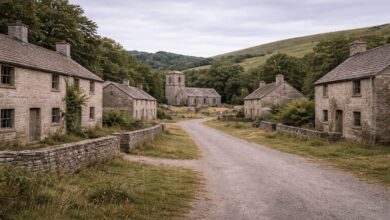
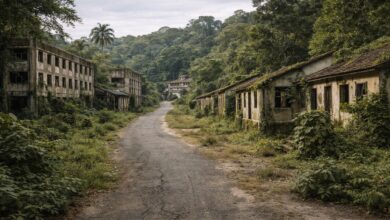
High in the Owyhee Mountains of Idaho, the abandoned settlement of Silver City sits above sagebrush valleys and exposed ridgelines. Wooden buildings line graded streets. A hotel, schoolhouse, jail, and church still stand, many with roofs intact and interiors recognizable. Yet no one lives here. Silver City was not erased by fire or flood. It was left behind as mining declined, leaving behind a complete townscape without the population it was built to serve.
What distinguishes Silver City is balance. Enough remains to understand daily life clearly, yet nothing functions anymore. The town exists in a narrow space between preservation and abandonment, where absence defines experience more than decay.
A town shaped by mineral promise
Silver City was founded in the mid nineteenth century after rich silver deposits were discovered in the surrounding mountains. Prospectors, merchants, and laborers arrived quickly, drawn by the promise of extraction.
The town grew with unusual confidence for such a remote location. Streets were laid out deliberately. Buildings were substantial. Civic life developed alongside mining operations. Similar human responses to silence and environment appear in abandoned village of Houtouwan.
Silver City was not a temporary camp. It was built to last.
Isolation as both asset and burden
The town’s elevation and distance from major routes offered protection and independence, but also imposed limits. Supplies traveled slowly. Winters were harsh. Economic survival depended almost entirely on mining output.
As long as ore flowed, isolation was manageable. When it slowed, isolation became decisive.
Distance amplified vulnerability.
Decline without a defining moment
Silver City did not experience a single catastrophic event. Instead, mining yields diminished, investment shifted, and opportunities elsewhere became more attractive.
Families left gradually. Businesses closed one by one. Public services followed.
The town emptied without spectacle.
Buildings left standing by circumstance
Because Silver City declined slowly, structures were not abandoned in panic. Homes were closed. Furniture was removed selectively. Buildings were left intact rather than stripped.
Remote location discouraged large scale scavenging or redevelopment.
As a result, the town retained its physical coherence.
Streets that still organize movement
Silver City’s streets remain clearly legible. Boardwalks outline former storefronts. Residential lanes still guide the eye uphill and down.
Urban order persists even without activity.
This clarity heightens awareness of absence.
Public buildings without public life
The schoolhouse, hotel, and jail remain among the most prominent structures. Their scale reflects collective life rather than individual use.
Without residents, these buildings feel oversized and unfinished.
Public absence feels heavier than private absence.
The desert climate as conservator
The high desert climate slowed decay. Low humidity and limited vegetation reduced structural collapse.
Wood weathered but did not rot quickly. Rooflines held.
Environment preserved form without intention.
Why the town feels inhabited despite emptiness
Visitors often describe Silver City as feeling occupied, even when it is not. This sensation does not rely on narrative or belief.
It comes from order. Buildings face streets correctly. Doors align. Windows suggest interior life.
The mind supplies what space implies.
Absence without disorder
Unlike settlements destroyed by disaster, Silver City lacks chaos. There are no collapsed streets or violent breaks.
Order remains. Only repetition is missing.
Order without repetition unsettles.
Comparison with other mining towns
Many mining towns were dismantled, relocated, or reduced to foundations. Silver City retained a large portion of its built environment.
This completeness distinguishes it.
The town reads as a system rather than a trace.
Memory shaped by structure
Because buildings remain, memory attaches easily. One can imagine routines without effort.
Structure does the work of remembering.
This ease intensifies reflection.
Ethical restraint in engagement
Silver City is often romanticized as a picturesque ghost town. While visually compelling, its history reflects economic precarity and displacement.
Responsible framing avoids nostalgia without context.
The town represents ambition that could not sustain itself.
Time without reinvention
No new identity replaced Silver City’s original purpose. It did not become industrial, residential, or agricultural again.
Time passed without transformation.
Stasis defines its condition.
Presence rooted in layout
Reports of presence in Silver City often stem from spatial awareness. The town’s layout suggests oversight, routine, and return.
These sensations arise from design, not mystery.
Design outlives use.
A town that stopped quietly
Silver City did not announce its end. It simply became less necessary.
When necessity vanished, so did population.
Buildings remained as witnesses.
Why Silver City still matters
Silver City matters because it demonstrates how towns can disappear socially while remaining physically intact. It challenges the idea that abandonment always involves destruction.
Here, disappearance was administrative and economic.
The town slipped out of use rather than out of existence.
Between endurance and absence
Silver City endures materially while absent socially. This duality defines its atmosphere.
One can walk its streets and recognize a town.
What cannot be recognized is life.
A settlement defined by vacancy
Silver City’s identity is vacancy without collapse. It remains a town in form but not in function.
Vacancy becomes its defining feature.
The town exists as an outline of former certainty.
Enduring Perspective
Silver City endures as a high desert mining town where structures remain but residents vanished. Its power lies in restraint. Nothing dramatic announces its end. Instead, buildings stand quietly, maintaining order long after purpose dissolved.
In the Idaho high desert, Silver City reminds us that towns do not always fall apart. Sometimes they simply become unnecessary. When that happens, architecture continues to occupy space, holding the shape of lives that moved on, leaving absence to speak where activity once did. Related reflections on memory and perception can also be found in mining settlement of Garnet.
Horizon Report documents places shaped by memory, infrastructure, and human decisions. Our editorial approach focuses on what remains physically visible, how abandonment unfolds over time, and how interpretation is clearly separated from observable evidence.
For readers seeking deeper context, the following background articles explore how ghost towns emerge, why communities are left behind, and why preservation matters in understanding collective history.
- Abandonment And Ghost Towns
- What Is A Ghost Town
- Why Towns Are Abandoned
- Preserving Abandoned Places
Editorial transparency matters. Observations are grounded in site layout, materials, remaining structures, and documented timelines where available. Interpretive layers are presented as interpretation, not assertion.
Careful readers often notice details worth refining. Thoughtful feedback helps ensure accuracy, clarity, and long term editorial integrity.