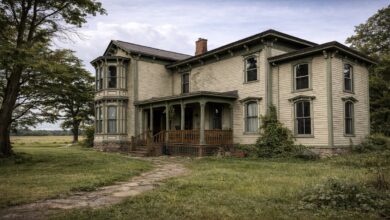
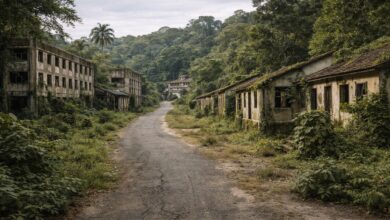
On the Jurassic Coast of southern England, within rolling chalk hills and quiet farmland, the abandoned village of Tyneham, Dorset remains suspended in an unusual state of absence. In 1943, during the Second World War, its residents were ordered to leave so the land could be used for military training. The evacuation was described as temporary. The return never came.
What remains today is not a village lost to neglect, but one deliberately held in place. Restricted access, controlled decay, and preserved domestic structures give Tyneham a distinct tension. Its silence is not accidental. It is maintained.
Absence here was imposed.
A village cleared, not abandoned
Before the evacuation, Tyneham was a small agricultural community with stone cottages, a school, and a parish church. Families had lived there for generations, bound by routine and landscape. When the order arrived, residents were given limited time to leave homes they believed they would one day reclaim.
Furniture remained. Doors were closed carefully. The departure was orderly, shaped by trust in authority and the expectation of return. Similar human responses to silence and environment appear in abandoned village of Imber, England.
That expectation was never fulfilled.
Military necessity and permanence
Once Tyneham became part of a military training area, its status quietly changed. Live fire exercises, long term planning, and strategic value made civilian resettlement increasingly impractical.
No single decision permanently erased the village. Instead, temporary measures hardened into permanence. Time replaced intent. What was once emergency use became default condition.
The village was not reclaimed. It was absorbed.
Buildings that still expect return
Tyneham’s buildings retain a domestic scale that distinguishes the village from typical ruins. Window frames, staircases, fireplaces, and garden walls suggest interruption rather than abandonment.
The village school still carries traces of instruction. The church of St Mary remains structurally cared for, signaling respect without restoration. These spaces feel paused, not concluded.
Expectation lingers in form.
Restricted access as preservation
Unlike many abandoned settlements, Tyneham did not decay freely. Military control limited vandalism, redevelopment, and casual intrusion. Access was restricted for decades.
This protection preserved structure, but deepened absence. The village remained visible yet unreachable, present but unavailable.
Stillness became policy.
Lives interrupted rather than erased
Tyneham’s story is not one of economic collapse or environmental failure. It is a story of displacement. Families relocated and adapted elsewhere while their original homes remained behind military boundaries.
Daily routines ended mid course. Meals were never resumed. Lessons were never completed. Generations were redirected rather than erased.
Continuity was severed.
A landscape shaped by control
The surrounding fields and hills remain active with military use, reinforcing the sense that Tyneham exists within an operational landscape rather than a forgotten one.
The village feels observed rather than abandoned. Authority remains present, even in silence. Control defines atmosphere.
Why Tyneham still resonates
Tyneham matters because it demonstrates how absence can be maintained rather than accidental. It shows how communities can be displaced without destruction, leaving places intact but unresolved.
The village does not rely on decay to communicate loss. Its clarity lies in what was preserved and withheld.
It remains incomplete. Related reflections on memory and perception can also be found in mining settlement of Garnet.
Enduring Perspective
Tyneham endures as a village defined by interruption rather than ruin. Its buildings remain upright. Its streets remain legible. Yet the lives that shaped them were redirected and never returned. Held in place by restricted access and institutional necessity, Tyneham demonstrates how displacement can preserve form while dissolving continuity. Here, absence is not decay. It is enforced stillness.
Horizon Report documents places shaped by memory, infrastructure, and human decisions. Our editorial approach focuses on what remains physically visible, how abandonment unfolds over time, and how interpretation is clearly separated from observable evidence.
For readers seeking deeper context, the following background articles explore how ghost towns emerge, why communities are left behind, and why preservation matters in understanding collective history.
- Abandonment And Ghost Towns
- What Is A Ghost Town
- Why Towns Are Abandoned
- Preserving Abandoned Places
Editorial transparency matters. Observations are grounded in site layout, materials, remaining structures, and documented timelines where available. Interpretive layers are presented as interpretation, not assertion.
Careful readers often notice details worth refining. Thoughtful feedback helps ensure accuracy, clarity, and long term editorial integrity.