Rising above the clay hills of southern Italy, the abandoned village of Craco stands intact yet empty. Stone houses cling to a narrow ridge. Streets wind upward toward a silent church tower. From a distance, the village appears preserved, almost complete. Up close, its stillness is unmistakable. Craco was not destroyed by war or fire. It was evacuated because the ground beneath it could no longer be trusted.
Craco’s reputation does not stem from legend. It arises from interruption. Landslides and geological instability forced residents to leave, but the settlement itself remained largely standing. The result is a place where everyday life ended abruptly, leaving behind a visible pause that continues to shape how the village is experienced.
A village shaped by elevation and defense
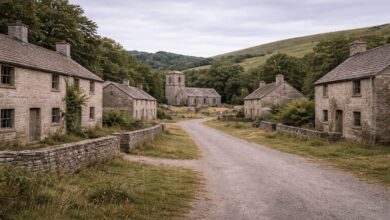
Craco’s origins date back to the medieval period, when hilltop locations offered protection and visibility. Built on a steep ridge, the village grew vertically rather than outward. Homes, stairways, and communal spaces were layered tightly together, adapting to limited buildable land.
This compact structure fostered strong social proximity. Daily life unfolded in shared spaces. Sound carried easily. Movement followed predictable paths. Similar human responses to silence and environment appear in Ruins of Kuldhara.
The same elevation that once provided security would later become a liability.
Geological conditions beneath the surface
Craco sits on unstable clay rich soil, prone to erosion and movement. For centuries, small landslides occurred without forcing abandonment. Over time, however, increased instability accelerated ground displacement.
By the twentieth century, landslides began to damage structures significantly. Cracks appeared in walls. Streets shifted. Foundations weakened.
The danger was gradual but cumulative.
Evacuation without destruction
Unlike towns erased by catastrophe, Craco was evacuated in stages. Authorities declared areas unsafe. Residents relocated to newly built settlements nearby.
Importantly, buildings were not demolished. They were left where they stood, vulnerable but intact.
Life moved elsewhere. Architecture remained.
Empty homes and preserved form
Walking through Craco today reveals interiors still shaped for habitation. Doorways open into rooms sized for family life. Windows frame views once familiar.
Furniture and personal belongings were largely removed, but the spatial imprint of domestic routine remains.
This preservation of form without function reinforces a sense of suspended time.
Streets without destination
Craco’s streets lead nowhere now. Staircases rise toward closed doors. Alleys narrow into silence.
Urban environments are designed for movement toward purpose. When purpose disappears, movement feels incomplete.
Visitors experience this incompleteness physically.
Silence amplified by isolation
The surrounding landscape is sparsely populated. Wind moves through empty windows. Birds cross rooftops.
Without traffic, commerce, or voices, sound is minimal. Silence is not total, but it is dominant.
In a village built for density and social proximity, silence becomes conspicuous.
Why unease is often reported
People frequently describe unease when encountering Craco. This response is not rooted in fear, but in contradiction.
The village appears ready for use, yet it is uninhabitable. Structures suggest continuity, while absence denies it.
The mind struggles to reconcile these signals.
Suspension rather than ruin
Craco does not feel ruined in the traditional sense. Rooflines remain. Walls stand. The skyline is legible.
It feels paused rather than destroyed.
This pause is unsettling because it resists narrative closure.
Comparison with other abandoned villages
Many abandoned settlements decay quickly or are dismantled. Craco’s partial preservation sets it apart.
Landslides made occupation impossible but did not erase form.
The village exists between survival and collapse.
Cultural memory and forced departure
For former residents, Craco represents loss without catastrophe. Homes were left not because of choice, but necessity.
Relocation preserved community, but severed place.
That severance contributes to the village’s emotional gravity.
The hilltop silhouette as symbol
Seen from afar, Craco’s silhouette remains dramatic and complete. Church towers and clustered homes outline a recognizable settlement.
This intact skyline contrasts sharply with the absence of life within it.
The image reinforces the idea of time stopped rather than ended.
Modern attention and preservation
Craco has attracted filmmakers, photographers, and researchers precisely because of its condition. Access is restricted to protect both visitors and remaining structures.
Preservation efforts focus on stabilization rather than restoration.
The goal is to hold the pause, not reverse it.
Geography as final authority
Ultimately, Craco’s fate was determined by geology. Human planning yielded to natural movement.
There was no failure of society or economy. The land itself withdrew permission.
This inevitability shapes interpretation.
Presence without narrative
Unlike sites dominated by legend, Craco offers no singular story to explain its atmosphere. There are no defining events to dramatize.
Instead, presence emerges from emptiness aligned with intact form.
Atmosphere replaces narrative.
Time made visible
Craco allows time to be seen spatially. Past use is evident. Future use is impossible.
The present feels elongated.
This temporal distortion is central to the village’s impact.
Ethical distance and restraint
Craco is not an attraction in the conventional sense. It represents displacement and risk.
Engagement requires restraint. Sensational framing obscures the reality of evacuation and loss.
The village deserves observation rather than projection.
A settlement defined by interruption
Craco did not transition into something else. It stopped being a place of daily life while remaining physically present.
That interruption left architecture without continuity.
Architecture without continuity demands reflection.
Enduring Perspective
Craco endures as an evacuated hilltop settlement where landslides halted life without erasing form. Its intact silhouette and empty homes create a rare condition in which time appears suspended rather than past.
The village does not tell a dramatic story. It presents a condition. Stability was lost, and life adjusted elsewhere, leaving behind a complete structure without function. Related reflections on memory and perception can also be found in Nazca Lines.
In the hills of Basilicata, Craco remains a visible pause in human settlement. Its power lies not in mystery, but in the clarity of interruption. What stands is not a ruin, but a reminder that place can persist even after life is forced to move on.
Horizon Report documents places shaped by memory, infrastructure, and human decisions. Our editorial approach focuses on what remains physically visible, how abandonment unfolds over time, and how interpretation is clearly separated from observable evidence.
For readers seeking deeper context, the following background articles explore how ghost towns emerge, why communities are left behind, and why preservation matters in understanding collective history.
- Abandonment And Ghost Towns
- What Is A Ghost Town
- Why Towns Are Abandoned
- Preserving Abandoned Places
Editorial transparency matters. Observations are grounded in site layout, materials, remaining structures, and documented timelines where available. Interpretive layers are presented as interpretation, not assertion.
Careful readers often notice details worth refining. Thoughtful feedback helps ensure accuracy, clarity, and long term editorial integrity.