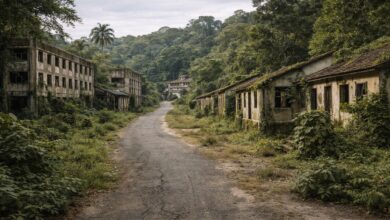
At the southeastern tip of Pamban Island, where the waters between India and Sri Lanka narrow into a shifting corridor of sand and sea, lies Dhanushkodi. Once a functioning town with homes, roads, a railway station, and a harbor, Dhanushkodi is today a landscape of ruins exposed to wind, salt, and sun. It is not abandoned through neglect or economic decline, but through sudden natural catastrophe.
In December 1964, a powerful cyclone struck this narrow strip of land, destroying the town almost entirely. What remained was deemed unsafe for resettlement. Since then, Dhanushkodi has existed in a state of permanent abandonment. Its silence is not symbolic or mythic. It is the direct result of geography, vulnerability, and the long memory of disaster.
A town shaped by location
Before its destruction, Dhanushkodi occupied a strategic and cultural position. It stood at the meeting point of the Bay of Bengal and the Indian Ocean, near the shallow chain of sandbanks known as Adam’s Bridge or Rama Setu. The town functioned as a minor port and railway terminus, linking mainland India to maritime routes toward Sri Lanka.
Its location offered opportunity but also risk. The land is narrow, low lying, and exposed on both sides to open water. Even in calm conditions, the coastline shifts. Sand moves. Tides reshape the shore.
For decades, Dhanushkodi balanced between these forces, sustained by trade, pilgrimage traffic, and local life. Similar human responses to silence and environment appear in Bhangarh Fort.
Daily life before the storm
In the mid twentieth century, Dhanushkodi was home to several thousand residents. There were schools, churches, temples, shops, and a railway station connecting the town to the rest of Tamil Nadu. Fishermen worked the surrounding waters. Pilgrims passed through on their way to nearby religious sites.
Life here was modest but structured. Buildings were simple, adapted to coastal conditions. The town’s rhythm followed tides, trains, and seasonal weather.
This normalcy makes what followed more striking. Dhanushkodi did not decline gradually. It ended abruptly.
The cyclone of 1964
On the night of December 22, 1964, a severe tropical cyclone made landfall near Dhanushkodi. Accompanied by extreme winds and a storm surge, the cyclone overwhelmed the town. Waves swept across the narrow landmass, collapsing buildings and tearing apart infrastructure.
A passenger train approaching Dhanushkodi was caught in the storm. Several carriages were washed into the sea. Communication lines failed. Rescue efforts were limited by weather and isolation.
By morning, much of the town was destroyed. Casualties were significant, though exact numbers remain uncertain. What survived structurally was rendered unstable.
Decision to abandon
In the aftermath, authorities assessed the damage and the risks of rebuilding. Given the town’s exposure, lack of natural protection, and the scale of destruction, Dhanushkodi was declared unfit for habitation.
Residents were relocated inland. Services were withdrawn. Rail lines were cut back. The town was not rebuilt.
This decision marked a rare moment when nature, rather than economics or politics, dictated abandonment. Dhanushkodi became a place without future development plans.
Ruins shaped by the sea
Today, the remains of Dhanushkodi lie scattered along the coast. Walls without roofs. Doorways opening to sand. A roofless church facing the sea. Sections of the old railway station partially buried and eroded.
The ruins are not preserved. They are continuously reshaped. Salt air corrodes surfaces. Sand covers foundations. Waves occasionally reach structures that once stood inland.
Nothing here is stable. The town remains in transition between land and water.
A landscape of exposure
Dhanushkodi’s atmosphere is defined by exposure. There is little vegetation. Wind is constant. The horizon is wide and uninterrupted.
Sound behaves differently in such spaces. Waves dominate. Human noise dissipates quickly. The absence of shelter amplifies the sense of vulnerability.
Visitors often describe the place as quiet but not peaceful. The openness carries weight. There is no enclosure, no refuge. Only distance.
Between two seas
Geographically, Dhanushkodi occupies a rare position. It sits between two bodies of water with different currents and moods. One side faces calmer stretches. The other opens into rougher, more volatile sea.
This dual exposure contributes to the town’s fate. There is no safe side. No natural barrier. The land exists as a threshold.
That threshold quality defines Dhanushkodi today. It feels unfinished not because of decay alone, but because it stands where land itself is provisional.
Cultural and historical context
Dhanushkodi is sometimes referenced in religious narratives due to its proximity to Rama Setu, a site of significance in Hindu tradition. However, its abandonment is not rooted in myth or belief.
The town’s silence is historical and practical. It reflects how modern settlements can still be undone by natural forces beyond control.
This distinction is important. Dhanushkodi is not a legend. It is a documented outcome of environmental vulnerability.
Memory without restoration
Unlike other disaster sites, Dhanushkodi has not been rebuilt as a memorial or heritage town. There are no reconstructed streets or interpretive centers within the ruins.
This absence of restoration preserves authenticity, but it also leaves the site exposed to misinterpretation. Without explanation, silence can appear mysterious.
In reality, the story is clear. Nature acted. People adapted by leaving.
Tourism and caution
In recent years, Dhanushkodi has attracted visitors drawn by its stark landscape and historical weight. Access is limited, often dependent on weather and road conditions.
There are few services. No permanent facilities. This reinforces the sense that the area is not meant for prolonged stay.
Responsible visitation emphasizes awareness. The ruins are fragile. The environment is unpredictable. Dhanushkodi remains governed by the same forces that destroyed it.
Why Dhanushkodi endures
Dhanushkodi endures in memory because it represents a clear boundary. It shows where human planning ends and environmental reality asserts itself.
There is no mythic layer required to explain its abandonment. The evidence stands in stone and sand.
The town reminds observers that not all places can be reclaimed, and not all losses are symbolic. Some are physical and final.
A place defined by consequence
Dhanushkodi is not frozen in time. It continues to change. Each year, the sea takes more. Wind reshapes what remains.
This ongoing erosion is part of the story. The town was not only destroyed once. It is being erased slowly.
Yet even as structures fade, the outline of streets and buildings remains visible. Memory persists in form, if not in function.
Silence at the edge
Standing in Dhanushkodi today, one does not encounter fear or mystery. One encounters exposure. The sense of standing at the limit of settlement.
The land narrows. The sea widens. The ruins face outward, not inward.
Dhanushkodi does not ask to be interpreted. It asks to be observed carefully.
A lesson written in coastline
Ultimately, Dhanushkodi stands as a reminder of how geography shapes destiny. Its destruction was not the result of error or neglect, but of location.
The town existed where land was never guaranteed. When the sea reclaimed it, the decision was not to fight, but to withdraw.
This acceptance defines Dhanushkodi’s lasting presence.
It remains not as a haunted place, but as a quiet record of how nature can conclude human settlement without warning, leaving behind a shoreline where memory and erosion continue side by side. Related reflections on memory and perception can also be found in Isla de las Muñecas.
Horizon Report documents places shaped by memory, infrastructure, and human decisions. Our editorial approach focuses on what remains physically visible, how abandonment unfolds over time, and how interpretation is clearly separated from observable evidence.
For readers seeking deeper context, the following background articles explore how ghost towns emerge, why communities are left behind, and why preservation matters in understanding collective history.
- Abandonment And Ghost Towns
- What Is A Ghost Town
- Why Towns Are Abandoned
- Preserving Abandoned Places
Editorial transparency matters. Observations are grounded in site layout, materials, remaining structures, and documented timelines where available. Interpretive layers are presented as interpretation, not assertion.
Careful readers often notice details worth refining. Thoughtful feedback helps ensure accuracy, clarity, and long term editorial integrity.