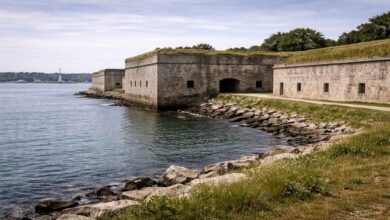
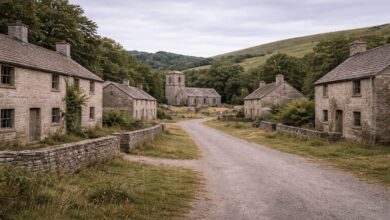
In the remote Pilbara region of Western Australia, the former town of Wittenoom exists in an unusual state of contradiction. It was not abandoned because the economy failed or residents drifted away. It was evacuated because remaining was dangerous. Asbestos contamination made daily life incompatible with survival. Over time, official maps removed the town’s name, roads were closed, and access was discouraged. Yet despite this deliberate erasure, Wittenoom did not disappear.
Buildings, streets, and fragments of domestic life remain. The land remembers what policy attempted to remove.
A town built around extraction
Wittenoom was established in the mid twentieth century to support nearby blue asbestos mining operations. At the time, asbestos was widely used and commercially valuable. Health risks were poorly understood or actively minimized.
The town was constructed with confidence. Homes, schools, shops, and recreational facilities were built to serve families, not transient labor. Wittenoom was presented as a permanent settlement in an otherwise harsh landscape. Similar human responses to silence and environment appear in Pyramiden.
Normality was engineered.
Asbestos as invisible threat
The asbestos mined near Wittenoom was not confined to shafts or factories. Dust spread through the air, settled on streets, and entered homes. Tailings were used for construction and landscaping.
Exposure was not limited to workers. Families, children, and visitors were affected.
The danger was not immediate or dramatic. It unfolded slowly, over decades.
The long recognition of harm
Medical evidence linking asbestos exposure to fatal disease accumulated gradually. Mesothelioma and other illnesses appeared long after exposure, obscuring cause and effect.
By the late twentieth century, the scale of harm associated with Wittenoom became undeniable. The town was recognized as one of the most severe industrial health disasters in Australian history.
Acknowledgment arrived after damage was irreversible.
Evacuation without closure
Authorities moved to evacuate Wittenoom progressively. Services were withdrawn. Residents were encouraged and later pressured to leave. Infrastructure was dismantled or allowed to decay.
Eventually, the town was officially degazetted. Roads were removed from maps. Signs warned against entry.
This was not abandonment by neglect. It was abandonment by design.
Attempted erasure
Unlike other abandoned towns preserved as heritage, Wittenoom was meant to vanish. Official policy aimed to discourage memory as much as presence.
There were no plans for memorialization on site. The risk was ongoing, and so was avoidance.
Yet erasure proved incomplete.
Physical traces that remained
Despite policy, physical traces persisted. House foundations, road alignments, building shells, and scattered structures remain visible.
These remnants resist abstraction. They anchor memory in place.
Even in decay, they assert that a town existed here.
Why unease persists
Visitors who encounter Wittenoom often report unease distinct from that felt in other abandoned settlements. The discomfort is not tied to mystery or legend.
It arises from known danger. The land itself carries harm.
This knowledge changes perception. Space feels compromised rather than empty.
Silence shaped by warning
Silence at Wittenoom is amplified by absence of permission. The lack of services, signage, and invitation reinforces the sense of exclusion.
This is not a place left behind accidentally. It is a place actively pushed away.
Silence becomes regulatory.
Domestic spaces without safety
Homes remain identifiable. Room layouts are visible. Streets still suggest routine movement.
Yet these domestic forms are inseparable from contamination. Familiarity collides with threat.
This collision unsettles because it contradicts expectations of home as refuge.
The difference between ruin and removal
Most abandoned towns fade gradually. Wittenoom was actively removed while still materially present.
This difference matters. Removal without disappearance creates tension between what is seen and what is denied.
Denial becomes visible.
Memory without monument
There is no central monument marking Wittenoom on site. Memory survives through absence rather than commemoration.
The lack of formal narrative leaves space for reflection rather than instruction.
The town remains unresolved.
Ethical boundaries and restraint
Engagement with Wittenoom raises ethical questions. Curiosity conflicts with safety. Documentation conflicts with respect for victims.
Responsible framing avoids sensationalism. The story here is not of exploration, but consequence.
The site demands distance.
Comparison with other industrial abandonments
Many industrial sites are abandoned due to economic obsolescence. Wittenoom was abandoned because continued existence was lethal.
This distinction defines its legacy.
It is not a relic of progress. It is evidence of cost.
Landscape as witness
The Pilbara landscape did not absorb Wittenoom quietly. Roads cut through red earth. Tailings altered terrain.
Even as vegetation reclaims space, the imprint remains.
The land carries history physically.
Presence without legend
Unlike many abandoned towns, Wittenoom has not generated folklore of unexplained presence. Its gravity does not need embellishment.
The facts are sufficient.
What remains is not mystery, but accountability.
Time that could not heal
Time often softens abandoned places. At Wittenoom, time deepened consequence. Diseases emerged long after evacuation.
Past and present remain entangled.
There is no clean division.
Why Wittenoom still matters
Wittenoom matters because it challenges how societies remember industrial harm. Erasing a town does not erase impact.
Maps can change. Names can be removed. Bodies remember.
Physical traces resist forgetting.
A place defined by warning
Wittenoom is defined not by what is experienced there now, but by what cannot safely be experienced at all.
The town’s absence is intentional. Its remains are accidental.
That imbalance shapes perception.
Enduring Perspective
Wittenoom endures as a town evacuated due to asbestos contamination, where official erasure failed to remove physical trace or human consequence. Its streets and structures persist as quiet contradiction to policy designed to forget.
This is not a place suspended in time. It is a place broken across time. Life ended here not in a moment, but through delayed recognition of harm.
In the red earth of Western Australia, Wittenoom remains a reminder that disappearance cannot be engineered cleanly. When danger is embedded into land and body, removal leaves behind more than absence. It leaves responsibility, unresolved and visible. Related reflections on memory and perception can also be found in Mining Settlement of Garnet.
Horizon Report documents places shaped by memory, infrastructure, and human decisions. Our editorial approach focuses on what remains physically visible, how abandonment unfolds over time, and how interpretation is clearly separated from observable evidence.
For readers seeking deeper context, the following background articles explore how ghost towns emerge, why communities are left behind, and why preservation matters in understanding collective history.
- Abandonment And Ghost Towns
- What Is A Ghost Town
- Why Towns Are Abandoned
- Preserving Abandoned Places
Editorial transparency matters. Observations are grounded in site layout, materials, remaining structures, and documented timelines where available. Interpretive layers are presented as interpretation, not assertion.
Careful readers often notice details worth refining. Thoughtful feedback helps ensure accuracy, clarity, and long term editorial integrity.