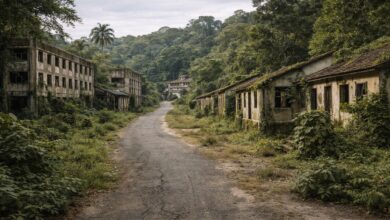
In the heart of the Atacama Desert, far from Chile’s coastal cities and agricultural valleys, lies Humberstone. Once a thriving industrial settlement built around nitrate extraction, Humberstone now stands preserved in a state of arrested time. Workshops, homes, schools, and leisure spaces remain visibly intact, creating an unusual continuity between past and present. This preservation, combined with abrupt economic collapse, has reinforced stories of lingering presence, not through myth alone, but through the visibility of interrupted daily life.
Humberstone is not a ruin reclaimed by forest or sand. It is a carefully conserved industrial town where personal spaces still feel recently occupied. Its reputation arises from how suddenly normal life stopped and how clearly that interruption can still be seen.
Industrial origins in the nitrate era
Humberstone was established in the late nineteenth century during the height of Chile’s nitrate boom. Saltpeter was essential for fertilizer and explosives, and global demand transformed the Atacama Desert into one of the world’s most important industrial regions.
The settlement was designed as a self contained company town. Extraction, processing, housing, education, and recreation were integrated into a single system. Workers and families lived within walking distance of factories. Similar human responses to silence and environment appear in Vulture City.
Humberstone existed to serve production, but it supported community life as well.
A structured industrial community
Life in Humberstone followed strict rhythms. Work shifts determined daily schedules. Housing reflected occupational hierarchy. Managers occupied larger homes, while laborers lived in standardized quarters.
Despite this structure, community developed. Schools educated children. A theater hosted performances. Sports fields and social clubs offered moments of relief from harsh desert conditions.
Personal identity and industrial function coexisted.
Domestic spaces and visibility
One of Humberstone’s defining features today is the visibility of domestic interiors. Bedrooms, kitchens, and storage areas remain recognizable. Furniture outlines persist. Tools sit where they were last used.
These traces of ordinary life are unusually clear for an abandoned settlement. They provide immediate emotional connection.
When personal space remains visible, absence becomes more pronounced.
Sudden decline and closure
Humberstone’s decline was rapid. The invention of synthetic nitrates in the early twentieth century destabilized the natural nitrate market. Demand fell. Operations slowed.
By the mid twentieth century, the settlement was no longer economically viable. Workers left in stages, but closure came quickly once production ceased entirely.
The town did not transition. It stopped.
Preservation rather than decay
Unlike many industrial sites that were dismantled or left to collapse, Humberstone was later preserved. Structures were stabilized. Layouts were maintained.
This preservation prevented erasure. Instead of becoming an indistinct ruin, Humberstone retained legibility.
Legibility sustains memory.
The psychology of intact abandonment
Abandoned places feel different when they remain structurally intact. Walls stand. Rooms remain defined. Paths still lead somewhere.
In Humberstone, this intactness encourages projection. Visitors imagine life continuing just beyond sight.
This psychological effect explains why stories of lingering presence emerge without requiring belief in unexplained phenomena.
Isolation in the desert
The Atacama Desert intensifies perception. Silence is profound. Distance is vast. Environmental conditions are extreme.
In such settings, human traces feel fragile. Their persistence feels unnatural.
The desert frames Humberstone’s stillness sharply.
Industrial noise replaced by silence
When Humberstone was active, machinery dominated soundscape. Engines, processing equipment, and voices filled the air.
Today, silence occupies the same spaces. This contrast is striking. Silence feels heavy because noise once defined the environment.
The absence of sound reinforces awareness of what ended.
Stories shaped by interruption
Accounts associated with Humberstone often focus on feeling rather than event. Visitors describe unease, awareness, or the sense of interruption.
These reactions are consistent with environments where activity ended suddenly and left visible traces behind.
The town feels paused rather than finished.
UNESCO recognition and responsibility
Humberstone is recognized as a UNESCO World Heritage Site, acknowledged for its historical and industrial significance. This designation emphasizes preservation and education rather than narrative embellishment.
Official interpretation focuses on labor history, industrial organization, and economic transition.
The site’s value is documentary.
Labor, identity, and loss
For those who lived in Humberstone, closure meant more than job loss. It meant the disappearance of a complete social world.
Company towns collapse not only economically, but socially. Identity tied to place dissolves quickly.
The town’s emptiness reflects that loss.
Comparison with other company towns
Many company towns declined gradually, transforming into cities or being dismantled. Humberstone’s abrupt end and later preservation set it apart.
Most comparable settlements lost domestic detail. Humberstone retained it.
Retention amplifies emotional impact.
The role of personal objects
Objects left behind carry disproportionate weight. Shoes, tools, signage, and furniture imply recent use.
These items are not staged. They are remnants.
Remnants provoke stronger response than abstract history.
Presence as perception
Stories of lingering presence at Humberstone do not rely on specific claims. They arise from environmental cues. Intact rooms. Silent machinery. Open spaces.
Presence here describes awareness, not entity.
It reflects human response to suspended routine.
Education through space
Humberstone functions as a spatial archive. Visitors learn not through text alone, but through movement within preserved structures.
This embodied learning deepens impact.
History becomes navigable.
Why the town endures in memory
Humberstone endures because it shows how industrial life ended abruptly, not gradually. Its preservation resists forgetting.
The town remains a visual record of economic shift.
Memory stays anchored.
Between industry and humanity
While Humberstone was built for production, its remains emphasize humanity. Domestic life is visible. Personal routines are implied.
Industry fades into background.
People come forward.
A settlement defined by pause
Humberstone does not feel destroyed. It feels paused. That pause is unsettling because it resists narrative completion.
There is no visible catastrophe. Only cessation.
Cessation leaves questions.
Enduring Perspective
Humberstone stands as a preserved industrial settlement where sudden decline interrupted everyday life without erasing it. Homes, schools, and workplaces remain legible, reinforcing a sense of presence rooted in visibility rather than myth.
Its power lies in clarity. One can see where life happened and where it stopped.
In the Atacama Desert, under relentless sun and silence, Humberstone remains not as a mystery to decode, but as a reminder of how quickly systems collapse and how deeply personal space anchors memory. The town endures because it allows absence to be seen, not imagined. Related reflections on memory and perception can also be found in Bodie.
Horizon Report documents places shaped by memory, infrastructure, and human decisions. Our editorial approach focuses on what remains physically visible, how abandonment unfolds over time, and how interpretation is clearly separated from observable evidence.
For readers seeking deeper context, the following background articles explore how ghost towns emerge, why communities are left behind, and why preservation matters in understanding collective history.
- Abandonment And Ghost Towns
- What Is A Ghost Town
- Why Towns Are Abandoned
- Preserving Abandoned Places
Editorial transparency matters. Observations are grounded in site layout, materials, remaining structures, and documented timelines where available. Interpretive layers are presented as interpretation, not assertion.
Careful readers often notice details worth refining. Thoughtful feedback helps ensure accuracy, clarity, and long term editorial integrity.