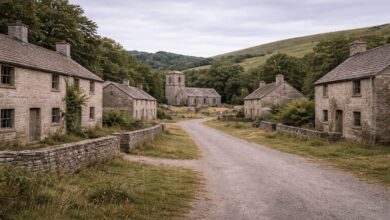
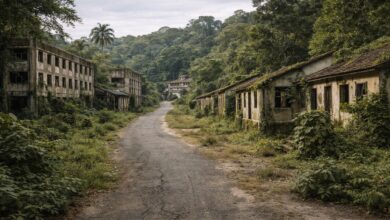
In central France, north of Limoges, the ruins of Oradour-sur-Glane stand exactly where a living village once functioned. Shops, homes, workshops, and streets remain in place, but none were rebuilt. After a wartime massacre in 1944, the site was preserved as it was left, burned and emptied in a single afternoon. Oradour-sur-Glane is not an abandoned town in the usual sense. It is a deliberate suspension of time, maintained so that absence itself becomes evidence.
What gives Oradour its enduring gravity is not mystery or rumor. It is precision. The layout is intact. The interruption is complete. History is not inferred here. It is encountered.
A functioning village before interruption
Before its destruction, Oradour-sur-Glane was an ordinary rural community. Streets supported daily commerce. Homes were lived in. Children attended school. Trades and farming structured the local economy.
There was no military significance to the village. Its routines mirrored those of countless settlements across the region. Similar human responses to silence and environment appear in Ruins of Belchite.
This ordinariness is essential to understanding its impact.
The event that ended daily life
In June 1944, the village was destroyed during a wartime reprisal that resulted in the mass killing of its civilian population. Buildings were burned. Survivors were few. Life ended abruptly and irreversibly.
The scale of loss was total in social terms. Families were erased. Continuity ended.
After the war, a decision was made not to rebuild on the same site.
Preservation as testimony
Rather than reconstructing Oradour-sur-Glane, the French state preserved the ruins as a memorial. Walls remained where they fell. Streets were left open. Objects stayed where they were found.
This choice transformed the village into a document. It would not be edited, simplified, or symbolically reimagined.
Preservation here means refusal to overwrite.
Streets without movement
Walking through Oradour today means following streets that still function spatially but not socially. Pavement leads past storefronts without goods, homes without occupants, vehicles that never moved again.
Movement feels incomplete. The village still directs the body, but no longer offers destination.
This bodily experience deepens understanding without narration.
Objects as fixed moments
Personal and commercial objects remain visible. A sewing machine rusts where it stood. A car frame sits in the road. Tools remain in workshops.
These items do not suggest decay over time. They suggest interruption at a specific moment.
Time did not wear them away. It stopped around them.
Silence defined by intention
The silence at Oradour is not accidental. It is protected. The absence of noise reflects the site’s role as a place of remembrance rather than use.
Silence here functions as a boundary. It signals that this space is not neutral ground.
Visitors respond by slowing, lowering voices, and observing.
Why unease is commonly reported
Visitors often describe unease, but it is not confusion or fear. It is clarity. The cause of absence is known, and it is visible.
Unlike places where explanation is missing, Oradour offers certainty. That certainty is heavy.
Unease arises from comprehension rather than ambiguity.
Preservation without reconstruction
No attempt was made to rebuild the village as it was. Reconstruction would have implied continuity.
Instead, a new village was built nearby. The old one remained untouched.
This separation allows memory to exist without reuse.
Architecture as historical record
Oradour’s buildings are not ruins shaped by neglect. They are ruins shaped by decision.
Walls still outline rooms. Windows still frame streets. The architecture communicates function even without activity.
The village remains legible.
Comparison with other memorial sites
Many memorials abstract loss through symbols. Oradour does not abstract. It presents.
This directness distinguishes it from monuments that interpret history on behalf of the viewer.
Here, interpretation emerges from encounter.
Ethical engagement and restraint
Oradour-sur-Glane requires restraint from those who visit. Photography, movement, and behavior are guided by respect rather than curiosity.
The site does not invite exploration. It invites attention.
Attention here is an ethical act.
Memory anchored in place
The choice to preserve Oradour fixed memory geographically. Loss is not displaced into narrative alone.
Place holds meaning.
This anchoring prevents forgetting through distance.
The absence of narrative embellishment
There are no legends attached to Oradour. No stories of unexplained presence or imagined continuation.
The site does not need them.
Its power comes from documentation rather than interpretation.
Why the village remains powerful
Oradour remains powerful because it resists closure. Nothing replaces what was lost. Nothing fills the gap.
The village stands as it was left, demanding recognition rather than resolution.
In doing so, it transforms absence into instruction.
Time made immobile
Time at Oradour does not flow. It remains fixed at the moment of destruction.
Visitors experience past and present simultaneously, without transition.
This immobility is intentional.
A landscape of responsibility
Oradour-sur-Glane is not a place to be explained away. It exists to remind, not to comfort.
Responsibility replaces curiosity.
Memory replaces story.
Enduring Perspective
Oradour-sur-Glane endures as a village destroyed and preserved after wartime massacre, where streets remain frozen exactly as they were left. Its impact lies in refusal to rebuild, refusal to soften, and refusal to allow history to fade into abstraction.
The village stands not as a ruin reclaimed by time, but as time halted by choice. In its empty streets and intact outlines, Oradour insists that remembrance is not symbolic. It is spatial, physical, and demanding.
Here, history is not something to be learned later. It is something encountered directly, where daily life once existed and was abruptly taken away. Related reflections on memory and perception can also be found in Abandoned Village of Craco.
Horizon Report documents places shaped by memory, infrastructure, and human decisions. Our editorial approach focuses on what remains physically visible, how abandonment unfolds over time, and how interpretation is clearly separated from observable evidence.
For readers seeking deeper context, the following background articles explore how ghost towns emerge, why communities are left behind, and why preservation matters in understanding collective history.
- Abandonment And Ghost Towns
- What Is A Ghost Town
- Why Towns Are Abandoned
- Preserving Abandoned Places
Editorial transparency matters. Observations are grounded in site layout, materials, remaining structures, and documented timelines where available. Interpretive layers are presented as interpretation, not assertion.
Careful readers often notice details worth refining. Thoughtful feedback helps ensure accuracy, clarity, and long term editorial integrity.