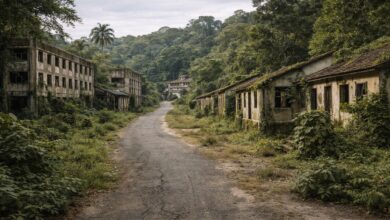
For decades, Kowloon Walled City existed as an anomaly within Hong Kong. Enclosed by its own boundaries yet surrounded by a modern metropolis, it became the most densely populated urban area ever recorded. Within a footprint of just a few hectares, tens of thousands of residents lived stacked in improvised towers of concrete and steel. When the city was demolished in the early 1990s, its physical presence vanished almost overnight. What remained was an absence that continues to shape memory, fear, and interpretation.
Kowloon Walled City was not a ruin born of ancient collapse. It was a living place shaped by legal uncertainty, rapid migration, and necessity. Its reputation, often reduced to chaos and danger, overshadows a more complex reality. Understanding Kowloon requires examining how extreme density formed, how everyday life functioned, and why the site’s removal left such a persistent imprint on collective imagination.
A place defined by legal ambiguity
The origins of Kowloon Walled City lie in nineteenth century geopolitics. After agreements that placed Hong Kong under British administration, the walled enclave remained nominally Chinese territory. This unresolved status created a space where neither government exercised full authority.
Over time, this ambiguity allowed informal settlement to expand. Regulations were unclear or unenforced. Building codes were ignored. The city grew vertically and inward, shaped more by opportunity than by planning. Similar human responses to silence and environment appear in Poveglia Island.
The absence of governance did not mean absence of order. It meant order emerged differently.
Migration and necessity
Following the Second World War and the Chinese Civil War, waves of migrants arrived in Hong Kong seeking safety and work. Housing shortages were severe. Kowloon Walled City offered a rare option: space that could not easily be regulated or cleared.
Families built homes where they could. Additions were made on top of existing structures. Narrow gaps became corridors. Rooftops became living areas.
The city expanded upward until it reached aviation height limits imposed by the nearby Kai Tak Airport.
Architecture without architects
Kowloon Walled City had no master plan. Buildings were constructed incrementally, often without professional design. Concrete slabs, steel beams, and brick walls were added wherever possible.
The result was a dense labyrinth. Sunlight rarely reached ground level. Corridors twisted unpredictably. Water pipes and electrical cables ran openly across walls and ceilings.
Despite this, the city functioned. Residents adapted architecture to daily needs.
Life inside the density
Contrary to its reputation as lawless, Kowloon Walled City supported ordinary life. Schools, small factories, clinics, shops, and places of worship operated within its confines.
Many residents described strong community ties. Neighbors depended on one another. Informal networks provided security, childcare, and employment.
Children played on rooftops. Meals were shared. Daily routines developed despite the lack of formal infrastructure.
Health and safety challenges
Extreme density came at a cost. Ventilation was poor. Sanitation systems were strained. Fire risk was constant. Emergency access was limited.
These conditions contributed to health challenges and reinforced external perceptions of danger. Yet they also reflected broader inequalities in housing access rather than inherent disorder.
Kowloon Walled City concentrated problems that existed elsewhere, but at an unprecedented scale.
Crime and exaggeration
Organized crime did operate within the city at various times, particularly in earlier decades. Gambling and unlicensed businesses existed. However, portrayals often exaggerated these elements.
By the 1970s and 1980s, crime rates had declined, and many residents reported feeling safer inside the city than in surrounding areas.
Fear attached to Kowloon was amplified by unfamiliarity and density rather than by daily reality alone.
Sensory experience and perception
One reason Kowloon Walled City left such a strong impression was its sensory environment. Sound echoed constantly. Light was filtered and uneven. Smells overlapped.
Human perception responds strongly to such conditions. Crowding increases stress. Darkness and noise heighten alertness.
For outsiders, brief visits could feel overwhelming. For residents, adaptation reduced impact.
The decision to demolish
By the late twentieth century, the legal ambiguity that allowed Kowloon Walled City to exist was no longer tolerated. Agreements between governments cleared the way for removal.
Residents were compensated and relocated. Demolition began in 1993. Within months, the city was gone.
Its disappearance was total. No buildings were preserved. The site was cleared down to the ground.
Absence as a legacy
Where Kowloon Walled City once stood, a public park was created. Green space replaced concrete mass. Paths replaced corridors.
This transformation altered the area physically, but not psychologically. The absence itself became meaningful. A place once defined by excess became defined by emptiness.
Memory filled what space removed.
Cultural afterlife
Kowloon Walled City continues to appear in films, games, books, and art. It is often portrayed as dystopian, dangerous, or lawless.
These representations draw on visual density and legend rather than lived complexity. They reflect fascination with extremes.
The city’s image has become symbolic rather than descriptive.
Fear and nostalgia
For some former residents, memory carries nostalgia rather than fear. Community bonds, resilience, and identity remain central to their recollections.
For others, memory is shaped by hardship and confinement. Both perspectives coexist.
The city’s meaning depends on where one stood within it.
Why Kowloon still matters
Kowloon Walled City matters because it demonstrates what happens when human need collides with legal gaps and rapid urbanization. It shows how informal systems can sustain life under extreme conditions.
It also reveals how quickly such systems can be erased when political will aligns.
The city’s destruction removed risk, but it also removed a unique social structure.
Not a failure, but a response
It is tempting to frame Kowloon Walled City as a failure of planning. In reality, it was a response to exclusion. People built where they were allowed to remain.
Its density was not chosen for efficiency. It was chosen for survival.
Understanding this reframes the narrative from fear to necessity.
Architecture as evidence of adaptation
The city’s form documented human adaptability. Stacked homes, shared utilities, and improvised solutions reflected ingenuity under constraint.
These qualities are often overlooked in favor of spectacle.
Yet they explain how tens of thousands lived there for decades.
Memory without monument
Because no physical structure remains, Kowloon Walled City survives only through documentation and recollection. Photographs, maps, and personal stories carry its legacy.
This lack of monument intensifies myth. Without material reference, imagination fills gaps.
The city becomes larger in memory than it ever was in space.
A cautionary reflection
Kowloon Walled City offers lessons about urban inequality, governance, and human resilience. It shows how density alone does not define quality of life, and how absence of regulation does not equal absence of community.
Its removal resolved immediate issues but did not resolve broader housing pressures that created it.
The conditions that produced Kowloon exist elsewhere.
Between fear and understanding
Fear remains attached to the idea of Kowloon Walled City because it represented loss of control. Yet understanding reveals structure where chaos was assumed.
The city was not unknowable. It was unfamiliar.
This distinction matters when interpreting its legacy.
An erased city that persists
Kowloon Walled City no longer stands, but it persists as an idea. Its image continues to circulate, detached from geography.
The absence left by its destruction is filled by memory, narrative, and projection.
In that sense, Kowloon was not ended. It was transformed.
Once the most densely populated place on Earth, it now exists only in recollection, where fear and fascination overlap. Its story reminds us that cities are not just built. They are negotiated, inhabited, and remembered long after their walls are gone. Related reflections on memory and perception can also be found in Skinwalker Canyon.
Horizon Report documents places shaped by memory, infrastructure, and human decisions. Our editorial approach focuses on what remains physically visible, how abandonment unfolds over time, and how interpretation is clearly separated from observable evidence.
For readers seeking deeper context, the following background articles explore how ghost towns emerge, why communities are left behind, and why preservation matters in understanding collective history.
- Abandonment And Ghost Towns
- What Is A Ghost Town
- Why Towns Are Abandoned
- Preserving Abandoned Places
Editorial transparency matters. Observations are grounded in site layout, materials, remaining structures, and documented timelines where available. Interpretive layers are presented as interpretation, not assertion.
Careful readers often notice details worth refining. Thoughtful feedback helps ensure accuracy, clarity, and long term editorial integrity.