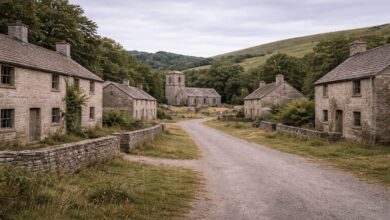
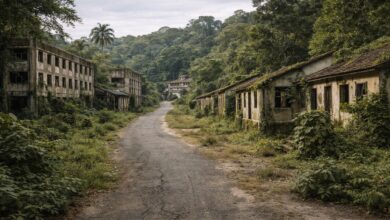
High in the eastern mountains of California, beyond the busy corridors of modern travel, the former mining town of Bodie stands in deliberate stillness. Wind moves through empty streets. Wooden structures lean but do not fall. Inside homes and shops, personal belongings remain where they were last used. Bottles sit on shelves. Chairs face tables. Curtains hang in windows. Bodie is not simply abandoned. It is preserved through absence.
Unlike many ghost towns that collapsed through neglect or were dismantled for materials, Bodie entered a rare condition known as arrested decay. This approach has allowed the town to remain largely unchanged for decades. The result is a place where everyday life appears paused rather than erased. That visibility has reinforced stories of lingering presence, though the power of Bodie lies not in mystery, but in how preservation shapes perception.
From discovery to boom
Bodie’s story began in the late nineteenth century with the discovery of gold in the surrounding hills. What started as a small camp quickly expanded as mining operations intensified. By the late 1870s, Bodie had grown into a full scale town with thousands of residents.
At its height, Bodie supported saloons, hotels, schools, churches, newspapers, and businesses. The population fluctuated rapidly, shaped by the unpredictable success of mining claims. Wealth and hardship existed side by side. Similar human responses to silence and environment appear in Pyramiden.
This instability defined Bodie from the start. It was a town built on opportunity rather than permanence.
Life on the edge of certainty
Daily life in Bodie reflected the challenges of remote settlement. Winters were harsh. Supplies arrived slowly. Law enforcement struggled to keep pace with population changes.
Despite its reputation for roughness, Bodie was also home to families, children, and routine. Schools operated. Meals were prepared. Domestic spaces reflected ordinary life rather than constant chaos.
This balance between volatility and normalcy is essential to understanding the town’s later legacy.
Decline without catastrophe
Bodie did not fall due to fire, flood, or conflict. Its decline was gradual and economic. As gold production decreased and more profitable mines opened elsewhere, residents began to leave.
Businesses closed. Services diminished. Buildings were abandoned one by one. By the early twentieth century, the population had dwindled significantly.
There was no single moment of departure. Bodie emptied over time, leaving behind layers of occupation.
Abandonment and environment
Located in a dry, high altitude climate, Bodie benefited from conditions that slowed decay. Low humidity reduced rot. Cold winters limited biological growth.
These environmental factors preserved structures and interiors more effectively than in many other abandoned towns. Objects left behind remained intact longer than expected.
The environment did not erase Bodie. It held it.
The choice to preserve
In the mid twentieth century, the state of California recognized Bodie’s historical value. Rather than restoring buildings or clearing interiors, officials chose preservation through arrested decay.
This meant stabilizing structures to prevent collapse while leaving interiors untouched. Furniture, tools, and personal items were not removed or reorganized.
The town became a record rather than a reconstruction.
Interiors as evidence
Walking through Bodie today, visitors encounter rooms frozen in arrangement. Plates remain on tables. Beds are made. Shelves hold goods.
These details create a powerful impression. The absence of people contrasts sharply with the presence of objects. It feels recent, even though decades have passed.
This sensory contradiction reinforces the sense of lingering presence often associated with the town.
Stories and interpretation
Over time, stories emerged suggesting that Bodie is haunted. Visitors report feelings of unease or heightened awareness. Such responses are common in preserved environments where personal artifacts remain.
Psychological research shows that intact domestic spaces trigger empathy and imagination. The mind fills gaps when context is incomplete.
In Bodie, preservation amplifies this effect. The town does not explain itself. It displays.
No mystery in departure
Despite its reputation, there is no mystery surrounding Bodie’s abandonment. Records clearly document economic decline and population movement.
The sense of lingering presence arises not from unresolved events, but from unresolved arrangement. Objects remain where people expect them to be used.
The town appears ready for return, even though no return occurred.
Respect and restraint
Bodie is protected as a historic park, and strict rules govern visitor behavior. Removing objects is prohibited. Even small disturbances are considered damage.
This restraint preserves the integrity of the site. It also reinforces its emotional impact. The town remains untouched because it must remain credible.
Preservation here is an ethical choice as much as a technical one.
The power of arrested decay
Arrested decay differs from restoration. Restoration replaces loss. Arrested decay acknowledges loss and prevents further change.
In Bodie, this approach preserves imperfection. Peeling paint, warped wood, and weathered signs are not corrected.
These elements reinforce authenticity. The town feels real because it is unfinished.
Absence as a presence
Bodie demonstrates how absence can become a form of presence. When people leave but their environments remain intact, memory becomes spatial.
Rooms remember through layout. Streets remember through alignment. Objects remember through position.
This spatial memory shapes visitor experience more strongly than narrative alone.
A contrast to modern development
Modern urban spaces are constantly updated. Objects are replaced. Interiors are redesigned. Traces of previous occupants are erased quickly.
Bodie resists this pattern. It preserves continuity rather than novelty.
This resistance makes it feel closer than it is. The past appears accessible.
Why Bodie endures
Bodie endures because it offers clarity. It shows how towns rise and fall through economic cycles. It shows how ordinary life ends without ceremony.
Its preservation allows visitors to encounter history without interpretation imposed.
The town speaks through what remains.
Not a spectacle, but a record
Despite popular framing, Bodie is not a stage for fear. It is a record of settlement, labor, and departure.
Its quiet streets do not conceal secrets. They display outcomes.
The emotional response it evokes reflects empathy rather than threat.
Between history and imagination
Bodie sits at the boundary between documented history and personal interpretation. Facts explain its rise and decline. Objects invite imagination.
Neither cancels the other. Together, they create depth.
Understanding Bodie requires holding both.
A town held in time
Ultimately, Bodie is compelling because it was allowed to stop without being erased. Its buildings stand. Its belongings remain. Its story is complete, yet visible.
This completeness gives rise to stories of lingering presence. Not because something unseen remains, but because so much seen remains without explanation.
Bodie does not haunt. It remembers.
In its preserved stillness, the town offers a rare opportunity to encounter the everyday textures of a past life left exactly where it ended. That quiet continuity is what gives Bodie its enduring power. Related reflections on memory and perception can also be found in Centralia.
Horizon Report documents places shaped by memory, infrastructure, and human decisions. Our editorial approach focuses on what remains physically visible, how abandonment unfolds over time, and how interpretation is clearly separated from observable evidence.
For readers seeking deeper context, the following background articles explore how ghost towns emerge, why communities are left behind, and why preservation matters in understanding collective history.
- Abandonment And Ghost Towns
- What Is A Ghost Town
- Why Towns Are Abandoned
- Preserving Abandoned Places
Editorial transparency matters. Observations are grounded in site layout, materials, remaining structures, and documented timelines where available. Interpretive layers are presented as interpretation, not assertion.
Careful readers often notice details worth refining. Thoughtful feedback helps ensure accuracy, clarity, and long term editorial integrity.