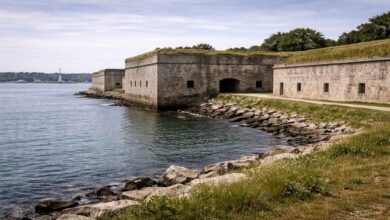
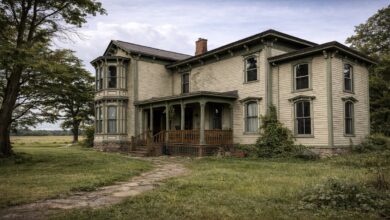
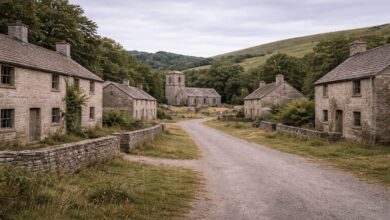
On the remote archipelago of Svalbard, far north of the Arctic Circle, the abandoned town of Pyramiden stands remarkably intact. Rows of apartment blocks, a school, a cultural center, and even a statue of Lenin remain in place, largely unchanged since residents departed in the late 20th century. Unlike many abandoned settlements shaped by war or disaster, Pyramiden’s silence arrived without visible rupture. Life appears to have paused rather than collapsed.
Pyramiden’s preservation is not the result of careful curation alone. It is the outcome of climate. Cold, dryness, and limited biological activity slowed decay, allowing everyday spaces to remain legible decades after abandonment. Kitchens still hold utensils. Offices retain paperwork. Gymnasiums display faded sports equipment. The town’s quiet power lies in this visibility. It presents ordinary life without commentary, inviting observation rather than explanation.
A planned Arctic community
Pyramiden began in the early twentieth century as a coal mining settlement. Although located on Norwegian territory, Svalbard’s unique legal status allowed international economic activity, and the town was later developed extensively by the Soviet Union. It was designed not as a temporary work camp, but as a model community intended to demonstrate that a full, cultured life could exist in the high Arctic.
Urban planning reflected this ambition. Housing blocks were arranged for sunlight exposure. Public buildings occupied central positions. A library, theater, music rooms, and sports facilities were included alongside essential services. The goal was stability and permanence, not mere extraction.
This vision set Pyramiden apart from many remote industrial sites. It was built to feel complete. Similar human responses to silence and environment appear in Centralia.
Everyday life at the edge of the world
At its height, Pyramiden housed several hundred residents. Families lived there year round. Children attended school. Cultural events filled evenings during long polar nights. The settlement offered amenities uncommon even in larger Arctic towns.
Food was shipped in regularly. Greenhouses supplemented supplies. A heated swimming pool operated year round. Life was structured and communal, shaped by schedules that balanced work with leisure.
Isolation was acknowledged but managed. Pyramiden was not intended to feel temporary or precarious. It was meant to feel normal, despite its latitude.
Architecture shaped by ideology and climate
Buildings in Pyramiden were functional rather than ornate, but they carried ideological weight. Clean lines, open spaces, and communal facilities emphasized collective life. Interiors were practical, designed to be warm, bright, and efficient.
Climate influenced every choice. Structures were built on pilings to accommodate permafrost. Materials were selected to withstand extreme cold and wind. Windows were sized to capture limited sunlight.
The result was a town that looked purposeful rather than improvised.
The mine and the settlement
Coal extraction sustained Pyramiden’s existence. The mine operated beneath the surrounding mountains, connected to the town through infrastructure that linked labor directly to daily life.
As global energy markets shifted and coal lost strategic importance, maintaining remote mines became increasingly difficult. Costs rose. Output declined. The economic logic that had justified Pyramiden weakened.
The town’s fate was tied to this change. When the mine could no longer sustain operations, the settlement lost its reason to exist.
Departure without drama
In 1998, the decision was made to close the mine and evacuate the town. Residents were relocated elsewhere in Svalbard or returned to mainland Russia. The departure was organized and calm.
There was no single catastrophic event. No visible damage. No emergency evacuation. People packed belongings, boarded ships, and left.
Because the exit was orderly, many items remained behind. Furniture, books, instruments, and tools stayed in place. The town emptied quickly, but gently.
Cold as preservation
What distinguishes Pyramiden from many abandoned places is how little it has changed since that departure. Arctic conditions slow decay dramatically. Low humidity limits mold. Cold temperatures inhibit rot and insect activity.
As a result, interiors remain recognizable. Objects stay where they were last used. Paper does not disintegrate quickly. Fabrics fade but endure.
This preservation creates an unusual experience. Visitors do not encounter ruins in the traditional sense. They encounter paused spaces.
Silence without erasure
Pyramiden’s silence is not emptiness. Wind moves through corridors. Snow accumulates on balconies. Light shifts across rooms that no longer host activity.
Yet the town does not feel erased. It feels intact but unused. The distinction matters. Many abandoned sites show violence through decay. Pyramiden shows restraint through stillness.
This quality challenges expectations about abandonment. The absence of destruction draws attention to absence of people.
Interpreting the pause
Because Pyramiden remains so legible, it invites interpretation. Why did life stop here. What happened. What changed.
The answer is not hidden. It is economic and logistical rather than mysterious. But the town’s condition makes that answer feel insufficient.
When everyday life remains visible, explanation feels secondary to observation. The mind searches for narrative, even when the cause is clear.
Not a monument, not a ruin
Pyramiden occupies a space between monument and ruin. It has not been restored to tell a story, nor left to collapse entirely. It exists as a record.
This in between state is deliberate. Limited maintenance ensures safety and prevents collapse, but the town is not reactivated. It is preserved without being repurposed.
The result is a place that documents itself.
Tourism and responsibility
Today, Pyramiden can be visited under guided conditions. Safety concerns, wildlife presence, and preservation requirements limit access. Guides emphasize respect for the site and its history.
Tourism here is observational rather than experiential. Visitors do not reenact life. They witness its outline.
This approach aligns with the town’s character. Pyramiden does not invite participation. It invites attention.
A broader Arctic context
Pyramiden is not unique in facing economic withdrawal, but it is unique in preservation. Many Arctic settlements adapted, shrank, or rebuilt. Pyramiden ended completely.
Its clarity highlights how single purpose communities function. When the purpose ends, the community ends with it.
The Arctic environment makes this process visible rather than obscured.
Why Pyramiden endures
Pyramiden endures because it reveals what usually disappears. The details of daily life. The arrangement of rooms. The tools of ordinary routines.
Most abandoned places lose these details quickly. Weather, vegetation, and human intervention erase them. Pyramiden retains them.
This retention transforms the town into a reference point for understanding planned communities, ideology, and economic dependency.
A lesson in completeness and fragility
Pyramiden was complete. It had culture, education, recreation, and infrastructure. It was not a rough outpost.
Yet completeness did not guarantee survival. When its foundational purpose ended, no alternative emerged.
This fragility is not a failure of design. It is a reality of specialization.
Time moving differently
In Pyramiden, time feels uneven. Objects suggest recent use, yet years have passed. Snow patterns change annually, but interiors remain similar.
This contrast disrupts ordinary perception. The town feels closer than it is.
Such temporal dissonance contributes to Pyramiden’s impact. It compresses past and present into one frame.
Between presence and explanation
Ultimately, Pyramiden’s power lies in its refusal to explain itself fully. The facts are known, but the experience remains open.
The town does not dramatize its ending. It presents it.
Cold preserved walls, rooms, and objects. People left. Life stopped.
Everything else is interpretation.
A settlement held by climate
Pyramiden stands today not as a warning or spectacle, but as a condition made visible. It shows how climate can preserve human traces long after human systems withdraw.
The Arctic did not erase the town. It held it.
In that holding, Pyramiden remains one of the clearest examples of how ordinary life can persist in material form without narrative reinforcement. A Soviet era settlement abandoned, yet not erased. A place where everyday life remains visible, and where the absence of explanation becomes part of the story itself. Related reflections on memory and perception can also be found in Kolmanskop.
Horizon Report documents places shaped by memory, infrastructure, and human decisions. Our editorial approach focuses on what remains physically visible, how abandonment unfolds over time, and how interpretation is clearly separated from observable evidence.
For readers seeking deeper context, the following background articles explore how ghost towns emerge, why communities are left behind, and why preservation matters in understanding collective history.
- Abandonment And Ghost Towns
- What Is A Ghost Town
- Why Towns Are Abandoned
- Preserving Abandoned Places
Editorial transparency matters. Observations are grounded in site layout, materials, remaining structures, and documented timelines where available. Interpretive layers are presented as interpretation, not assertion.
Careful readers often notice details worth refining. Thoughtful feedback helps ensure accuracy, clarity, and long term editorial integrity.