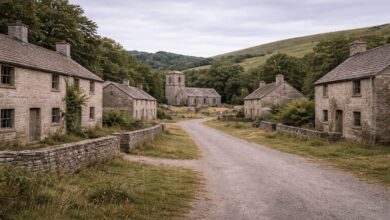
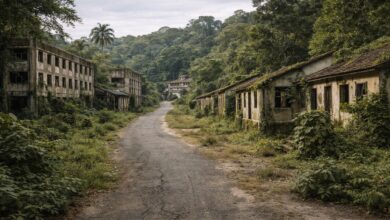
In the quiet rural landscape of Western New York, the estate known as Graestone Manor stands as a profound architectural anomaly. Constructed in 1865 during an era of significant social and economic transition, the manor was conceived as a self-contained world. Its stone walls, formal grounds, and controlled access were not merely aesthetic choices; they were intentional instruments of separation. From the beginning, this distance was not accidental. It was foundational.
What remains today is not simply a decaying mansion, but a structure shaped by the philosophy of withdrawal. Graestone Manor does not feel forgotten. It feels withheld. Every corridor and limestone block suggests that isolation was built into the original plan.
A Citadel of Victorian Privacy
Graestone Manor was constructed at a time when wealth often expressed itself through calculated isolation. In the mid-19th century, large estates functioned as personal domains, buffered from surrounding communities by land, architecture, and controlled entry. The manor’s design emphasized enclosure. Thick stone walls, limited sightlines, and carefully positioned buildings reduced visibility and approach. This was not a house meant to participate in village life. It was meant to remain apart. Privacy defined the total experience of the inhabitant. Similar human responses to silence and environment appear in Château Miranda.
Ambition Without Continuity
The scale of Graestone Manor reflected a confidence in permanence, yet its lifespan as an active residence was historically brief. Changes in ownership, shifting economic realities, and evolving social structures eventually undermined the estate’s original purpose. Unlike homes that adapt over generations, Graestone Manor did not evolve. Its function was narrowly defined, and once that definition failed, the building lacked a future role. Purpose ended faster than structure.
Architecture that Resists Occupation
The manor’s architecture remains imposing even in decline. Stone construction, formal symmetry, and a rigid layout convey authority rather than comfort. Interiors were designed to impress and control movement, not to invite flexibility. As abandonment progressed, this rigidity accelerated isolation. Rooms became unusable as systems failed. Scale worked against reuse. The manor resisted reintegration into ordinary life. It was built to stand alone.
Silence Shaped by Withdrawal
Unlike villages emptied by force or industry, Graestone Manor entered silence through retreat. There was no evacuation order and no sudden collapse. Occupation simply ceased. This gradual withdrawal created a different kind of absence. The building feels deliberately quiet. Its stillness carries intention rather than shock. Silence here is curated.
A Legacy Observed Through Distance
The reputation of the estate developed largely through physical and social distance. Restricted access, fencing, and limited visibility encouraged speculation. The manor became known more through its silhouette and rumor than through direct experience. This separation intensified its presence. Being seen but not entered amplified public perception. Distance shaped the very identity of the site.
That distance has also defined how the site has entered public awareness. Graestone Manor appears in an episode of Kindred Spirits, documented as part of the series’ broader focus on locations shaped by memory and unresolved histories. These references function only as markers of public media attention. The observations presented in this article are based exclusively on the site’s remaining physical evidence, architectural intent, and historical context.
Media Archive:
- YouTube Documentation: Kindred Spirits | Travel Channel
- IMDb Episode Reference: The Haunting Of Graestone Manor
Editorial Insight: Graestone Manor matters because it reveals how abandonment can result from design choices rather than disaster. It demonstrates how buildings created to exclude struggle to adapt when isolation becomes a liability. Control left behind creates a unique and enduring tension.
Enduring Perspective
Graestone Manor endures as a place shaped by deliberate separation. Built to exclude, it could not adapt when exclusion lost its value. Its stone walls still stand, but continuity dissolved quietly. In Gasport, Graestone Manor demonstrates how ambition and privacy can harden into isolation, and how silence, when chosen, can outlast presence. Withdrawal became permanent. Related reflections on memory and perception can also be found in ancient Ram Inn.
Horizon Report documents places shaped by memory, infrastructure, and human decision making. Our work focuses on what remains physically visible, how abandonment unfolds, and how interpretation is clearly separated from observable evidence.
For additional context, the following background articles explore patterns of abandonment, loss of use, and preservation.
- Abandonment And Ghost Towns
- What Is A Ghost Town
- Why Towns Are Abandoned
- Preserving Abandoned Places
Editorial transparency matters. Observations are grounded in site layout, materials, remaining structures, and documented timelines. Interpretation is presented as interpretation, not assertion.
Attentive readers often spot refinements worth making. Thoughtful feedback supports accuracy, clarity, and long term editorial integrity.