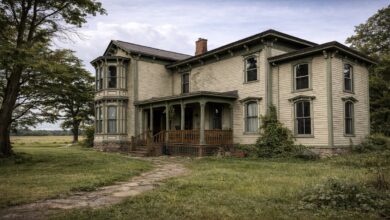
On a quiet stretch of land in San Jose, California stands one of the most unusual houses ever constructed in the United States. The Winchester Mystery House is neither grand in the traditional sense nor architecturally harmonious. Instead, it is confusing, layered, and endlessly curious. Staircases lead to ceilings, doors open into empty space, and rooms appear without purpose. Yet behind this maze lies a deeply human story shaped by grief, wealth, isolation, and belief.
The Winchester Mystery House is often described as haunted, cursed, or irrational. But beneath the legends is a long life spent trying to cope with loss in an era when science, superstition, and spiritualism overlapped. The house did not grow from a single vision. It grew day by day, room by room, as a response to fear and memory rather than design.
Sarah Winchester & sudden wealth
The story begins with Sarah Lockwood Winchester, a woman born into privilege but shaped by tragedy. She married William Wirt Winchester, heir to the Winchester Repeating Arms Company. The Winchester rifle became one of the most influential firearms of the nineteenth century, often referred to as the gun that won the American West.
Sarah’s personal life, however, was marked by loss. Her infant daughter died from illness, and years later her husband succumbed to tuberculosis. These losses left her emotionally adrift. When William died, Sarah inherited a vast fortune that provided financial freedom without emotional grounding.
In the late nineteenth century, spiritualism was widely practiced across the United States. Séances, mediums, and beliefs in communication with the dead were common among all social classes. Within this cultural context, Sarah reportedly sought spiritual guidance to understand her misfortune. Similar human responses to silence and environment appear in Story Of Señorita Petronilla.
The belief that shaped a house
According to popular accounts, Sarah was told that her family was haunted by the spirits of those killed by Winchester rifles. Whether she fully believed this narrative or used it as a framework to process grief remains debated. What is certain is that she became convinced that continual construction was necessary for her survival.
In 1886, Sarah moved west and purchased a modest farmhouse in California. What followed was nearly four decades of constant building. Construction reportedly continued day and night, with workers rotating shifts. There was no master plan. Instead, the house evolved organically, driven by impulse, intuition, and personal logic.
Rooms were added without purpose. Windows were installed facing walls. Staircases rose only to stop abruptly. The result was a sprawling structure with over 160 rooms at its height, forming a physical reflection of an unsettled inner world.
Architecture without symmetry
The Winchester Mystery House defies architectural logic. Traditional houses are built with balance and efficiency. This house rejects both. Corridors twist unexpectedly. Doors open onto sheer drops. Narrow staircases rise at odd angles, with shallow steps designed to accommodate Sarah’s arthritis.
Some features appear symbolic. The repeated use of the number thirteen is often cited, appearing in windows, steps, hooks, and drain holes. Whether this was intentional or coincidental is uncertain, but the pattern has fuelled speculation for generations.
Despite its confusion, the house was built with high craftsmanship. Sarah spared no expense on materials. Fine woodwork, imported glass, and custom details fill many rooms. Tiffany stained glass windows appear in unexpected places, sometimes installed where sunlight could never reach them.
Earthquake & transformation
In 1906, a massive earthquake struck San Francisco and surrounding regions. The Winchester house suffered significant damage. Several upper floors collapsed, trapping Sarah inside for hours. Afterward, she reportedly sealed off damaged sections and never rebuilt them.
This event marked a shift in the house’s development. Construction continued, but the building’s original seven stories were reduced. The earthquake added another layer of mystery, reinforcing beliefs that the house was unstable both physically and spiritually.
Rather than restoring symmetry, Sarah allowed the house to remain fragmented. Sealed rooms, hidden passages, and abandoned corridors became permanent features. The mansion no longer expanded upward, but inward and outward, deepening its labyrinthine character.
Life inside the maze
Sarah Winchester lived alone for most of her later life, accompanied by servants and construction workers. She rarely explained her choices publicly. To outsiders, she appeared eccentric. To those close to her, she was polite, reserved, and private.
Daily life in the house was quiet. Despite rumours of nightly séances, documentation suggests that Sarah led a structured routine. She oversaw construction, walked the grounds, and managed household affairs. The house was not chaotic in operation, only in design.
The maze-like structure may have served practical purposes as well. It provided privacy, distraction, and a sense of control. Constant building created rhythm and direction in a life otherwise defined by absence.
Myth, tourism, & reinterpretation
After Sarah’s death in 1922, the house was opened to the public. Almost immediately, stories of hauntings, ghosts, and curses became central to its identity. Guides emphasized mystery, reinforcing the supernatural reputation that continues today.
Yet modern historians and psychologists have offered alternative interpretations. The house can be viewed as a coping mechanism, a physical expression of grief shaped by cultural beliefs of the time. Continuous construction may have helped Sarah maintain purpose and avoid emotional stagnation.
Rather than madness, the house reflects adaptation. Faced with immense loss and limitless resources, Sarah built something that allowed her to live forward without resolving the past.
A mirror of human fear
The Winchester Mystery House endures because it touches something universal. It reflects how humans respond to uncertainty when answers are unavailable. Some seek order. Others build complexity. The house stands as a monument not to ghosts, but to unresolved questions.
Its walls do not tell a single story. They contain layers of belief, rumour, craftsmanship, and silence. Each hallway invites interpretation, and each dead end mirrors moments in life where direction disappears.
Today, visitors walk through the house searching for secrets. What they often find instead is perspective. The house reminds us that meaning is sometimes constructed rather than discovered, and that survival can take unexpected forms.
Legacy beyond the legend
More than a century later, the Winchester Mystery House remains difficult to define. It is part historical artifact, part psychological landscape, and part cultural myth. It resists reduction into a single explanation.
Its true mystery may not lie in spirits or curses, but in how one woman transformed grief into structure, motion, and endurance. The house stands not as a warning, but as a quiet testament to the lengths people go to keep moving when life no longer makes sense.
In its endless stairways and unfinished rooms, the Winchester Mystery House preserves a rare honesty. It does not pretend that loss resolves neatly. Instead, it shows how humans build forward anyway, even when the blueprint is uncertain. Related reflections on memory and perception can also be found in Asylum 49 in Utah’s Tooele Valley.
Horizon Report documents places shaped by memory, infrastructure, and human decisions. Our editorial approach focuses on what remains physically visible, how abandonment unfolds over time, and how interpretation is clearly separated from observable evidence.
For readers seeking deeper context, the following background articles explore how ghost towns emerge, why communities are left behind, and why preservation matters in understanding collective history.
- Abandonment And Ghost Towns
- What Is A Ghost Town
- Why Towns Are Abandoned
- Preserving Abandoned Places
Editorial transparency matters. Observations are grounded in site layout, materials, remaining structures, and documented timelines where available. Interpretive layers are presented as interpretation, not assertion.
Careful readers often notice details worth refining. Thoughtful feedback helps ensure accuracy, clarity, and long term editorial integrity.