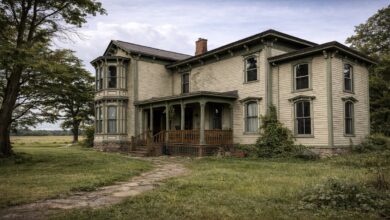
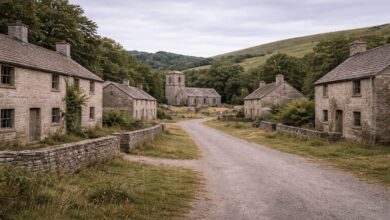
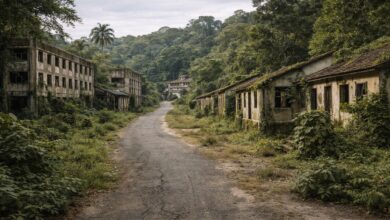
On the rugged southern edge of the Kenai Peninsula, overlooking cold waters and dense forest, the former fishing village of Portlock once supported a small but active community. Established in the early 20th century and officially known as Port Chatham, the settlement functioned as a seasonal hub for fishing, trapping, and timber work. By the mid twentieth century, it was completely abandoned.
What distinguishes Portlock from many remote Alaskan villages is not economic collapse or environmental disaster alone, but the way residents described their departure. Accounts emphasize fear, anxiety, and a sense that the place itself had become unsafe. These descriptions persist despite the absence of a single documented cause. Portlock’s story remains defined by uncertainty rather than resolution.
A practical beginning on a difficult coast
Portlock developed during a period when coastal Alaska attracted settlers seeking opportunity in fishing and resource extraction. The village’s location provided access to salmon runs and sheltered waters, while surrounding forests supported logging and trapping.
Life in Portlock followed a practical rhythm. Residents relied on seasonal work, shared labor, and maritime skill. The community was small, isolated, and accustomed to hardship. Isolation itself was not unusual. Many similar villages existed across Alaska at the time. Similar human responses to silence and environment appear in Pyramiden.
Portlock was not founded as an experiment or outpost. It was built for work.
Daily life and community ties
By the 1920s and 1930s, Portlock had a modest but stable population. Families lived year round or seasonally. Boats connected the village to other coastal settlements. Supplies arrived intermittently, reinforcing self reliance.
Community ties were essential. In remote environments, cooperation is not optional. People shared labor, watched weather closely, and relied on one another for safety.
This context matters when considering later accounts. Residents were familiar with risk. Fear was not easily triggered.
The beginning of unease
Sometime in the 1940s, residents began to describe Portlock differently. Accounts collected later suggest that people felt watched or threatened when moving through nearby forested areas. Some reported unexplained noises. Others described violent encounters without clear explanation.
These reports were not recorded systematically at the time. They survived through oral history and later retellings. Details vary. No single event marks the shift from routine to fear.
What remains consistent is the emotional description. People felt unsafe.
Disappearances and interpretation
Among the most frequently cited elements of Portlock’s story are reports of disappearances or deaths under unclear circumstances. In some accounts, individuals failed to return from routine activities. In others, bodies were reportedly found with injuries that residents struggled to explain.
Official records from the period are limited. Remote settlements often lacked consistent documentation. Weather, wildlife, and terrain complicate recovery and investigation.
The gap between experience and record left space for interpretation.
Environmental realities of the region
The Kenai Peninsula is a demanding environment. Dense forests, steep terrain, and large wildlife present real hazards. Bears, harsh weather, and limited visibility are constant factors.
Accidents in such conditions are not uncommon. However, Portlock residents framed their experiences differently. The danger they described felt intentional rather than environmental.
This distinction, whether factual or perceptual, shaped response.
Fear as a catalyst
Fear can function as a practical signal in isolated communities. When people believe risk has increased beyond tolerance, relocation becomes rational.
In Portlock, fear appears to have accumulated rather than erupted. One family left. Then another. Over time, remaining residents faced a shrinking support network.
Isolation increased as population declined. This likely reinforced unease.
Departure without formal closure
By the early 1950s, Portlock was empty. Residents relocated to nearby villages or larger towns. Homes, docks, and equipment were left behind.
There was no official evacuation order. No declared disaster. The settlement simply ceased to exist as a community.
Unlike places abandoned after catastrophe, Portlock’s end was quiet and administrative only in hindsight.
Absence of a single explanation
No definitive explanation for Portlock’s abandonment has been established. Economic pressures alone do not account for the suddenness of departure. Fishing communities elsewhere persisted through similar challenges.
Likewise, no verified external threat was identified. The lack of clear cause allowed fear itself to become the central narrative.
Portlock’s story is defined less by what happened than by what could not be explained at the time.
The role of oral history
Much of what is known about Portlock comes from oral accounts collected decades later. Such sources preserve emotional truth but can blur sequence and detail.
Oral history is shaped by memory, repetition, and cultural framing. Over time, stories evolve. Certain elements are emphasized. Others fade.
This does not invalidate the accounts. It situates them.
Cultural framing and later myth
In later decades, Portlock became associated with broader folklore traditions. These interpretations often reflected cultural attempts to explain fear retrospectively.
Such narratives are compelling but not verifiable. They emerge when documentation is sparse and emotional memory is strong.
Portlock became a container for unresolved experience.
The physical remains
Today, little remains of Portlock beyond foundations, scattered debris, and altered shoreline. Nature has reclaimed much of the site. Forest encroaches where buildings once stood.
The absence of intact structures limits archaeological clarity. The place does not explain itself materially.
What remains is location and memory.
Comparison with other abandoned villages
Many Alaskan settlements were abandoned due to economic change, environmental damage, or consolidation of services. These departures are usually well documented.
Portlock stands apart because residents described fear as the primary motivator. This does not make the explanation supernatural. It makes it psychological and social.
Fear can be as decisive as famine or flood.
Why Portlock endures in imagination
Portlock endures because it resists closure. There is no single report to cite, no event to mark, no conclusion to reach.
This ambiguity invites projection. The story continues because it remains unresolved.
In this sense, Portlock functions as a question rather than an answer.
Absence and interpretation
The empty site reinforces narrative. When a place is abandoned without explanation, absence itself becomes evidence for speculation.
Human perception fills gaps. Silence invites meaning.
Portlock’s lack of resolution is what sustains its reputation.
Between environment and emotion
Portlock existed in a harsh but familiar environment. Residents understood danger. When they chose to leave, it suggests a shift in perceived risk beyond normal tolerance.
Whether that perception was driven by environmental events, interpersonal conflict, cumulative stress, or misinterpreted incidents cannot be determined conclusively.
What matters is response. People left.
A village defined by decision
Portlock’s story is ultimately about decision making under uncertainty. Faced with fear they could not contextualize, residents chose safety through relocation.
That choice ended the village.
The lack of explanation does not negate the reality of their experience.
Memory without resolution
Today, Portlock exists primarily in memory and retelling. Its physical traces are minimal. Its narrative remains active.
The village was not destroyed. It was abandoned deliberately.
That distinction shapes interpretation.
A quiet lesson
Portlock reminds observers that communities do not always collapse visibly. Sometimes they dissolve through collective decision, driven by emotion rather than measurable cause.
Fear does not require verification to be effective.
The village’s story remains unresolved because it reflects a human response rather than an external event.
A place left behind
Portlock remains on the map, but not in use. Its coastline is quiet. Its forest is dense. Boats no longer arrive.
The absence left by its abandonment continues to attract attention because it cannot be explained fully.
A fishing village abandoned in the mid twentieth century, Portlock persists as a case where fear, memory, and environment intersected without leaving a clear record. Its story remains open, not because answers are hidden, but because none were ever firmly established. Related reflections on memory and perception can also be found in Hashima Island.
Horizon Report documents places shaped by memory, infrastructure, and human decisions. Our editorial approach focuses on what remains physically visible, how abandonment unfolds over time, and how interpretation is clearly separated from observable evidence.
For readers seeking deeper context, the following background articles explore how ghost towns emerge, why communities are left behind, and why preservation matters in understanding collective history.
- Abandonment And Ghost Towns
- What Is A Ghost Town
- Why Towns Are Abandoned
- Preserving Abandoned Places
Editorial transparency matters. Observations are grounded in site layout, materials, remaining structures, and documented timelines where available. Interpretive layers are presented as interpretation, not assertion.
Careful readers often notice details worth refining. Thoughtful feedback helps ensure accuracy, clarity, and long term editorial integrity.