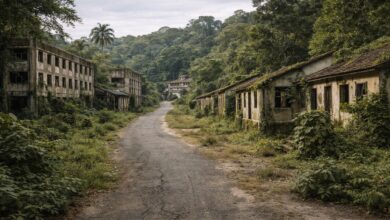
In the high desert of California, northeast of Barstow, the remains of Calico Ghost Town rise from arid hills in sharp relief. Wooden storefronts line dusty streets. Mine shafts puncture the surrounding slopes. The town appears intact, legible, and almost expectant. Calico’s ghost town identity is not the product of gradual decay. It was formed by speed. The same force that built the town rapidly also emptied it just as fast.
Calico’s reputation endures because its structures survived the collapse of purpose. The town did not dissolve into fragments. It remained recognizable, allowing absence to define it more strongly than ruin.
A boom built on extraction
Calico emerged in the early 1880s following the discovery of silver in the surrounding hills. The response was immediate. Prospectors, merchants, and laborers flooded into the area. Within a short span, Calico grew from a camp into a fully functioning town.
At its height, the settlement supported thousands of residents. There were saloons, hotels, general stores, schools, and newspapers. Streets followed a clear commercial logic. Calico was not provisional in appearance. It was built with confidence that the boom would last. Similar human responses to silence and environment appear in Vulture City.
Momentum shaped everything.
Speed as a defining condition
Few towns illustrate the volatility of extraction economies as clearly as Calico. The town expanded rapidly because silver prices justified expansion. When those prices fell, the economic foundation collapsed just as quickly.
Mining slowed. Investment vanished. Employment disappeared.
Residents left not because the town decayed, but because it ceased to function.
Abandonment without dismantling
Calico was left behind rapidly, but not violently. Buildings were closed rather than destroyed. Infrastructure remained in place. There was little incentive to dismantle structures in such a remote location.
As a result, the town retained its physical coherence. Streets stayed aligned. Facades remained upright.
The town was left whole enough to remember itself.
Architecture that sustains identity
Calico’s preserved structures are central to its ghost town identity. Wooden storefronts, balconies, and signage still communicate purpose even without activity.
These buildings do not require explanation. Their function is immediately recognizable.
Recognition intensifies absence.
The desert as a stabilizing force
The arid desert environment slowed decay. Low humidity and minimal vegetation reduced structural collapse. What weathering occurred was gradual.
Unlike towns reclaimed by forest, Calico remained exposed. Nothing concealed its form.
Visibility preserved memory.
Why Calico feels inhabited despite emptiness
Visitors often report that Calico feels occupied even when empty. This sensation does not stem from belief, but from clarity.
Spaces are arranged logically. Streets suggest movement. Interiors imply routine.
The mind completes what is missing.
Public spaces without public life
Saloons, hotels, and shops remain focal points. Their scale suggests gathering and exchange.
Without people, these spaces feel unfinished. Public absence is more noticeable than private absence.
Calico’s social core remains visible, making emptiness more pronounced.
The difference between abandonment and erasure
Calico was abandoned economically, not erased administratively. Unlike towns removed from maps or deliberately dismantled, Calico was left to stand.
This passive abandonment allowed later preservation.
The town transitioned from function to artifact.
Preservation and reinterpretation
In the twentieth century, Calico was stabilized and preserved. Efforts focused on maintaining historical appearance rather than modernizing structures.
This preservation reinforced its ghost town identity rather than replacing it.
The town became a reference point for what abandonment looks like when form survives.
Memory shaped by repetition
Because Calico remains intact, it has been photographed, visited, and referenced repeatedly. Repetition reinforces identity.
The town is remembered not for a single event, but for its condition.
Condition becomes narrative.
Comparison with other mining towns
Many mining towns collapsed physically or were scavenged for materials. Calico’s relative completeness distinguishes it.
It is not a trace. It is a framework.
Frameworks invite projection.
Ethical distance and historical clarity
Calico’s story is often simplified into romantic imagery. However, its history reflects labor volatility and economic precarity.
Boomtown optimism carried consequences.
Respectful framing acknowledges both aspiration and collapse.
Time suspended by preservation
Calico does not feel ancient. It feels paused. Buildings still define space. Streets still guide movement.
Time appears suspended between use and memory.
Suspension sustains interest.
Why Calico remains compelling
Calico remains compelling because it allows absence to be seen clearly. The town is not abstract. It is spatially complete.
Visitors do not imagine where life was. They see where it should be.
That clarity is powerful.
A town shaped by acceleration
Calico’s identity is inseparable from speed. Built quickly. Abandoned quickly. Preserved clearly.
Acceleration left little time for adaptation.
The town moved directly from activity to stillness.
Between history and sensation
Historical records explain Calico’s rise and fall. Sensation arises from how that history remains visible.
Understanding context deepens, rather than reduces, impact.
Form carries meaning.
A ghost town by definition, not myth
Calico does not rely on legend to justify its reputation. Its ghost town identity is architectural and economic.
Structures outlived purpose.
That is enough.
Enduring Perspective
Calico endures as a silver mining town left behind rapidly, where preserved structures maintain a strong ghost town identity without narrative embellishment. Its power lies in completeness rather than decay, in clarity rather than mystery.
The town stands as a reminder that abandonment does not always follow collapse. Sometimes it follows speed. When purpose disappears faster than structure, absence becomes visible.
In the California desert, Calico remains a fixed outline of ambition and withdrawal, a place where buildings stayed long after life moved on, leaving form to define memory. Related reflections on memory and perception can also be found in former Town of Wittenoom.
Horizon Report documents places shaped by memory, infrastructure, and human decisions. Our editorial approach focuses on what remains physically visible, how abandonment unfolds over time, and how interpretation is clearly separated from observable evidence.
For readers seeking deeper context, the following background articles explore how ghost towns emerge, why communities are left behind, and why preservation matters in understanding collective history.
- Abandonment And Ghost Towns
- What Is A Ghost Town
- Why Towns Are Abandoned
- Preserving Abandoned Places
Editorial transparency matters. Observations are grounded in site layout, materials, remaining structures, and documented timelines where available. Interpretive layers are presented as interpretation, not assertion.
Careful readers often notice details worth refining. Thoughtful feedback helps ensure accuracy, clarity, and long term editorial integrity.