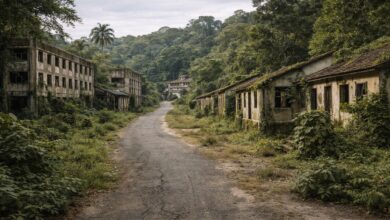
On Shengshan Island, off the eastern coast of China, the abandoned village of Houtouwan remains structurally intact yet visually transformed. Stone houses still stand in orderly rows. Rooflines remain legible. Walls have not fallen. Instead, vines, grasses, and shrubs have steadily enveloped the settlement, softening edges and filling windows until architecture and vegetation appear fused.
Houtouwan was not erased by catastrophe. It was overtaken by continuity. As residents departed gradually, nature did not wait for decay. It moved in immediately, reshaping the village without destroying it. The result is a place where time feels layered rather than broken.
A village shaped by the sea
Houtouwan developed as a fishing settlement during the twentieth century, oriented toward the surrounding waters that sustained it. Homes were built close together along steep terrain, maximizing limited flat ground. Paths and stairways connected houses vertically, forming a compact, efficient village.
Daily life followed the rhythm of tides and seasons. The village was not isolated socially, but it was geographically constrained. Access depended on boats, weather, and infrastructure that would later determine its fate. Similar human responses to silence and environment appear in ruins of Kuldhara.
Houtouwan functioned because proximity mattered.
Gradual departure rather than sudden loss
The village’s decline was not abrupt. As fishing yields diminished and younger generations sought opportunity on the mainland, population decreased steadily. Services became harder to maintain. Transportation remained difficult.
Families left over years rather than days. Homes were closed, not abandoned in panic.
This gradual departure allowed structures to remain intact.
Why buildings did not collapse
Houtouwan’s houses were built from stone and concrete, designed to withstand coastal weather. When residents left, roofs and walls did not immediately fail.
Without heavy reuse or demolition, buildings retained structural integrity. Doors and windows closed. Interiors were sealed.
The village was left whole enough for nature to respond differently.
Vegetation as quiet replacement
Once human maintenance ended, vegetation advanced quickly. Seeds carried by wind and birds took root in cracks and ledges. Moist coastal air supported dense growth.
Plants did not attack the buildings. They occupied available space. Windows became frames for green. Stairways turned into terraces of leaves.
Nature adapted to structure rather than removing it.
The difference between ruin and overgrowth
Most abandoned villages decay through collapse. Roofs fall. Walls crumble. Houtouwan followed another path.
Here, absence was filled before destruction occurred. Growth softened surfaces instead of breaking them.
The village did not become skeletal. It became camouflaged.
Silence shaped by continuity
Houtouwan is quiet, but not stark. Wind moves through leaves rather than empty rooms. Sound is absorbed, not echoed.
This kind of silence feels organic. It does not suggest interruption. It suggests transition.
The village feels less abandoned than repurposed.
Why presence is often felt
Visitors often describe a sense of presence in Houtouwan. This sensation is not linked to events or stories. It emerges from the coexistence of order and life.
Houses remain aligned. Paths still guide movement. Vegetation adds vitality rather than erasing intention.
The mind perceives continuity rather than loss.
Architecture as framework, not relic
In Houtouwan, architecture functions as a framework for natural growth. Buildings still define space. Plants respond to that definition.
Rooms become gardens. Balconies become terraces.
Human design remains readable beneath vegetation.
Comparison with other abandoned settlements
Many abandoned villages are reclaimed by forest over decades. Houtouwan’s transformation occurred rapidly and visibly.
Its coastal climate accelerated growth, while sturdy construction slowed decay.
The balance between preservation and change is unusually clear.
The role of climate and location
Frequent mist, rain, and mild temperatures support year round plant growth. Unlike arid or cold environments, nothing here slows vegetation.
Nature did not need time. It needed absence.
That absence arrived gradually, allowing growth to keep pace.
A village without trauma
Unlike sites abandoned due to disaster or violence, Houtouwan carries no singular traumatic event. There is no moment of rupture to explain.
This absence of trauma alters interpretation. The village feels calm rather than heavy.
Its story is one of drift, not shock.
Tourism and visual fascination
Houtouwan has gained attention because of its appearance rather than its history. Photographs emphasize green covered houses and stairways.
However, visual fascination can obscure context. The village was not created to be seen this way. Its condition is a byproduct, not an intention.
Understanding restores balance.
Ethical distance and restraint
While Houtouwan attracts visitors, respectful engagement matters. The village represents displacement through economic change.
Its transformation should not be romanticized as pure beauty. It reflects livelihoods lost and communities dispersed.
Growth followed absence. It did not replace it.
Time layered, not frozen
Houtouwan does not feel frozen in time. It feels layered. Past use and present growth coexist.
Time did not stop. It shifted direction.
This layering distinguishes Houtouwan from preserved ruins.
Nature as continuation, not erasure
In Houtouwan, nature did not erase human presence. It extended it in another form.
Walls still stand. Paths still lead. Vegetation follows lines laid by people long gone.
The village became a collaboration across time.
Why the village remains compelling
Houtouwan remains compelling because it shows what happens when absence is gradual and structure endures. It challenges assumptions about abandonment.
Not all places collapse. Some are absorbed.
Absorption feels quieter than loss.
Between memory and growth
For former residents, Houtouwan represents a home left behind. For visitors, it appears as transformation.
Both perspectives are valid, but incomplete alone.
The village holds both memory and growth without resolving the tension.
Enduring Perspective
Houtouwan endures as a fishing village reclaimed by vegetation, where nature overtook homes without structural collapse. Its power lies in continuity rather than rupture, in growth rather than decay.
The village does not confront visitors with disaster or warning. It offers a quieter lesson. When people leave slowly and structures remain strong, nature does not destroy. It adapts.
On Shengshan Island, Houtouwan stands as evidence that abandonment does not always mean erasure. Sometimes it means integration, where human order becomes the scaffold for a different kind of life. Related reflections on memory and perception can also be found in mining settlement of Garnet.
Horizon Report documents places shaped by memory, infrastructure, and human decisions. Our editorial approach focuses on what remains physically visible, how abandonment unfolds over time, and how interpretation is clearly separated from observable evidence.
For readers seeking deeper context, the following background articles explore how ghost towns emerge, why communities are left behind, and why preservation matters in understanding collective history.
- Abandonment And Ghost Towns
- What Is A Ghost Town
- Why Towns Are Abandoned
- Preserving Abandoned Places
Editorial transparency matters. Observations are grounded in site layout, materials, remaining structures, and documented timelines where available. Interpretive layers are presented as interpretation, not assertion.
Careful readers often notice details worth refining. Thoughtful feedback helps ensure accuracy, clarity, and long term editorial integrity.