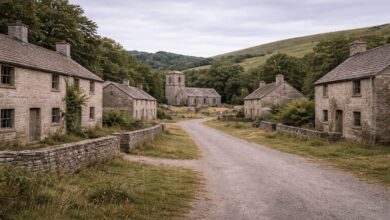
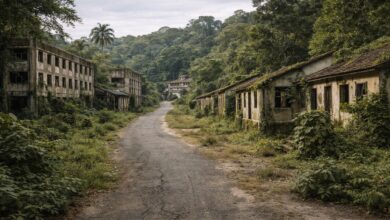
On the banks once traced by the Volga River, the former town of Mologa no longer exists as a continuous settlement. It was not abandoned through decline or emptied by conflict. Mologa was deliberately flooded in the early twentieth century to create the Rybinsk Reservoir, part of a vast hydroelectric project intended to modernize the region. Streets, homes, churches, and cemeteries were submerged beneath rising water. Yet disappearance was never complete. When water levels fall, remnants return, briefly interrupting the surface with stone, brick, and memory.
Mologa’s enduring impact lies in this oscillation between absence and return. The town is gone, but not erased. It surfaces intermittently, reminding observers that deliberate transformation can leave unresolved traces.
A functioning town before submersion
Before flooding, Mologa was a stable provincial town with deep historical roots. It supported trade, agriculture, religious life, and civic administration. Streets followed established routes. Churches marked communal centers. Homes reflected generational continuity rather than temporary use.
Life in Mologa unfolded slowly. There was no crisis demanding evacuation. The town functioned as it had for decades. Similar human responses to silence and environment appear in former town of Wittenoom.
This normalcy sharpens the contrast with what followed.
The logic of modernization
The decision to flood Mologa emerged from state led industrial planning. Hydroelectric power promised energy, navigation, and economic growth. Large reservoirs were considered symbols of progress.
From an administrative perspective, land could be repurposed. Settlements could be relocated. Water would serve national need.
From the ground level, however, relocation meant severance from place rather than transition within it.
Evacuation without continuity
Residents were forced to leave as water rose. Buildings were dismantled selectively, but much of the town remained in place as flooding advanced. Cemeteries, foundations, and stone structures could not be fully removed.
Relocation scattered community. Memory detached from geography.
The evacuation ended life in Mologa without replacing it locally.
Submersion as preservation
Water altered destruction into suspension. Unlike fire or demolition, flooding slowed decay. Walls and foundations remained protected beneath the surface.
This form of preservation is incomplete but persistent. The town exists in a submerged state, neither fully gone nor accessible.
Suspension defines its condition.
When the water recedes
During periods of low water, outlines emerge. Church walls appear. Foundations trace former streets. Objects surface briefly before disappearing again.
These moments are not restorations. They are exposures.
The town reveals itself just enough to confirm its persistence.
Streets without movement
When visible, Mologa’s remains still suggest movement. Paths align. Corners turn. Openings lead nowhere.
Urban logic survives without use.
This partial legibility unsettles because it implies continuation that cannot resume.
Silence shaped by water
Underwater, Mologa is silent in a literal sense. When exposed, silence becomes more complex. Wind moves through open structures. Water laps at edges.
Sound behaves inconsistently. It arrives, then dissipates.
The environment reinforces the sense of interruption.
Why unease is often reported
Unease associated with Mologa does not stem from uncertainty. Its history is documented. The cause of submersion is known.
Discomfort arises from intentionality. The town was not lost accidentally. It was sacrificed deliberately.
This knowledge changes how absence is perceived.
The difference between loss and replacement
Many towns disappear to make way for something new. In Mologa’s case, the replacement is abstract. A reservoir lacks streets, homes, or memory.
The town was replaced by utility rather than community.
Utility does not carry narrative.
Cemeteries and unresolved removal
Burial grounds were particularly difficult to relocate. Some graves were moved. Others were not. When water recedes, markers occasionally surface.
These moments confront observers with incomplete closure.
Death remained where life could not.
Landscape as archive
The reservoir surface conceals a layered archive. Beneath it lie foundations, artifacts, and routes that once structured daily life.
The landscape records decisions without commentary.
Exposure becomes the only form of testimony.
Comparison with other flooded settlements
Flooded towns exist worldwide, but few resurface as visibly or as frequently as Mologa. Its shallow submersion and wide reservoir make return possible.
Return distinguishes memory from legend.
Here, evidence interrupts forgetting.
Ethical attention and restraint
Engagement with Mologa requires restraint. The site represents displacement under state authority rather than natural disaster.
Romantic framing risks minimizing human consequence.
The town should be approached as record, not spectacle.
Time that oscillates
Mologa does not belong to a single temporal state. It alternates between invisibility and exposure.
This oscillation prevents narrative closure.
The past repeatedly intrudes into the present.
Presence without habitation
There are no residents, yet presence is felt when remains appear. Presence here does not imply observation. It implies endurance.
Stone persists where routine ended.
Persistence reshapes memory.
Why Mologa still matters
Mologa matters because it illustrates how progress can remove place while leaving trace. It shows that erasure through water is partial and reversible.
What is submerged is not forgotten.
The town returns to insist on recognition.
Between engineering and humanity
The reservoir represents engineering achievement. Mologa represents human cost.
Both occupy the same space.
Their coexistence resists simplification.
A town defined by reappearance
Mologa’s identity is not fixed disappearance. It is conditional return. The town emerges when circumstances allow.
Emergence disrupts the idea that flooding ended its story.
The story continues intermittently.
Enduring Perspective
Mologa endures as a town deliberately flooded for a reservoir, where parts still surface when water levels drop. Its power lies in refusal to remain hidden. Submersion preserved structure enough to allow return, even if only briefly.
The town does not ask to be restored. It asks to be acknowledged. Each exposure interrupts the smooth surface of modernization with evidence of what was displaced.
In the shifting waterline of the Rybinsk Reservoir, Mologa remains a reminder that planned disappearance is rarely complete. When land is repurposed, memory often resurfaces, shaped by stone, water, and unfinished history. Related reflections on memory and perception can also be found in ruins of Belchite.
Horizon Report documents places shaped by memory, infrastructure, and human decisions. Our editorial approach focuses on what remains physically visible, how abandonment unfolds over time, and how interpretation is clearly separated from observable evidence.
For readers seeking deeper context, the following background articles explore how ghost towns emerge, why communities are left behind, and why preservation matters in understanding collective history.
- Abandonment And Ghost Towns
- What Is A Ghost Town
- Why Towns Are Abandoned
- Preserving Abandoned Places
Editorial transparency matters. Observations are grounded in site layout, materials, remaining structures, and documented timelines where available. Interpretive layers are presented as interpretation, not assertion.
Careful readers often notice details worth refining. Thoughtful feedback helps ensure accuracy, clarity, and long term editorial integrity.