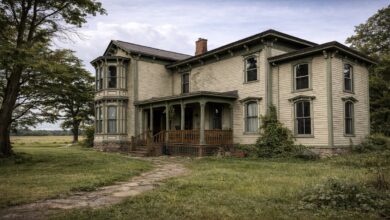
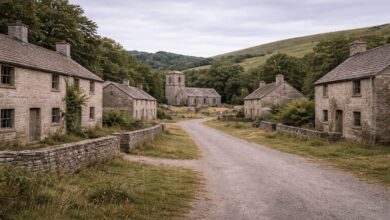
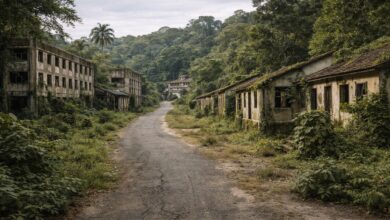
Hidden in the forested mountains of western Montana, the preserved mining settlement of Garnet stands apart from most abandoned towns. Unlike sites reduced to foundations or scattered debris, Garnet remains structurally complete. Cabins, hotels, a saloon, and civic buildings still stand. Inside many of them, furniture remains arranged as it was left. Chairs face tables. Beds sit beneath windows. Stoves occupy corners where meals were once prepared.
Garnet does not feel ruined. It feels paused. This condition, more than any story attached to the town, shapes its reputation for lingering presence. The sense that life stopped without being cleared away defines how the place is experienced.
A town formed by extraction and optimism
Garnet emerged in the late nineteenth century during a surge of gold mining activity. Like many western boomtowns, it developed rapidly, fueled by speculation, labor, and the promise of permanence. At its height, Garnet supported hundreds of residents, complete with businesses, schools, and social spaces.
The town was not provisional in its self image. Buildings were constructed for longevity. Streets followed a defined plan. Residents invested in homes rather than temporary shelters. Similar human responses to silence and environment appear in Pyramiden.
Garnet was built to last.
Domestic life still visible
What distinguishes Garnet today is the survival of domestic interiors. In many mining towns, structures remain but interiors are stripped. At Garnet, objects stayed.
Beds, dressers, shelves, and tables remain positioned as if occupants expected to return. The absence of personal clutter is noticeable, but so is the absence of removal.
This partial preservation creates a powerful cognitive response. The space suggests continuity even as it denies it.
Decline without disaster
Garnet did not collapse due to a single catastrophe. Mining output declined gradually. Economic activity slowed. Residents left in stages, seeking opportunity elsewhere.
Because departure was incremental, buildings were often closed rather than dismantled. Furniture was left behind because it had little value elsewhere or because return still seemed possible.
Expectation lingered longer than occupation.
Weather and preservation
Garnet’s remote location and cold winters contributed to its preservation. Reduced development pressure and seasonal inaccessibility limited vandalism and reuse.
Later, deliberate preservation efforts stabilized structures without modernizing them. Interiors were protected rather than emptied.
Preservation reinforced the impression of recent absence.
Why presence is often reported
Visitors frequently describe a sense of presence in Garnet. These accounts rarely involve specific events. Instead, they emphasize feeling watched, accompanied, or expected.
Psychologically, this response aligns with environments where domestic order remains intact. Furniture placement implies human intention. Intention suggests continuity.
The mind responds to implication.
Silence shaped by structure
Garnet is quiet, but not empty of sound. Wind moves through wood. Floors creak. Trees absorb distant noise.
In buildings designed for constant activity, such sounds feel directional rather than random. Silence becomes textured.
Auditory ambiguity invites interpretation.
Mining towns and communal proximity
Mining towns were socially dense. People lived close together. Work and home overlapped. Daily rhythms were shared.
This density leaves an imprint on architecture. Spaces feel sized for interaction. When empty, they feel incomplete rather than neutral.
Garnet’s buildings still expect use.
The saloon and public space
Public buildings, especially the saloon, concentrate attention. Chairs remain oriented toward shared tables. The bar still defines the room.
Such spaces were centers of social life. Their emptiness is particularly noticeable.
Social absence feels heavier than private absence.
Preservation without reenactment
Importantly, Garnet is preserved without reenactment. There are no staged scenes or interpretive displays meant to simulate life.
Objects remain where they were found, not arranged for effect.
This restraint allows the town to speak through absence rather than representation.
Memory embedded in layout
Walking through Garnet follows the same paths residents once used. Doors open into rooms still proportioned for human use.
The body moves as if activity might resume.
This embodied experience deepens perception more than explanation could.
Comparison with other ghost towns
Many ghost towns are skeletal. Foundations mark where life once existed. Garnet retains volume, enclosure, and interior space.
Volume changes perception. Empty rooms feel different from open ground.
Garnet’s intactness sets it apart.
The role of expectation
Stories of lingering presence tend to follow sites like Garnet because expectation is built into the environment. People do not arrive expecting ruins. They arrive expecting interruption.
When surroundings reinforce that expectation, sensation intensifies.
Narrative follows experience, not the reverse.
Ethical engagement with preserved absence
Garnet represents labor, aspiration, and displacement. It is not a stage. Respectful engagement means observing rather than inserting story.
The preservation of furniture is not an invitation to imagine freely. It is a reminder that real lives ended here without ceremony.
Absence deserves restraint.
Time without transition
Garnet does not clearly belong to the past or present. It has not been repurposed, nor has it fully decayed.
This temporal ambiguity creates the sensation of suspended time.
Suspension is more unsettling than closure.
Why Garnet endures
Garnet endures because it resists erasure and refuses completion. The town was not destroyed, redeveloped, or absorbed.
It remains in a state of waiting.
Waiting invites attention.
Between history and sensation
The documented history of Garnet explains its decline. Sensation arises from how that history remains visible in space.
Understanding context does not dissolve the experience. It frames it.
Experience and explanation coexist.
A town defined by pause
Garnet is defined by pause rather than collapse. Life slowed, stopped, and never resumed, yet left its shape intact.
The town does not ask to be imagined differently. It asks to be recognized for what it is.
A preserved interruption.
Enduring Perspective
Garnet stands as a mining town left intact, where furniture and buildings remain preserved and daily life appears only recently interrupted. Its reputation for lingering presence does not rely on legend, but on continuity denied rather than erased.
The power of Garnet lies in implication. Chairs still face tables. Beds still sit beneath windows. Rooms still expect occupants who never returned.
In the mountains of Montana, Garnet remains a rare example of how absence can feel immediate when structure and intention survive together. It reminds us that places do not need stories added to feel full. Sometimes, what was left behind is enough. Related reflections on memory and perception can also be found in Humberstone.
Horizon Report documents places shaped by memory, infrastructure, and human decisions. Our editorial approach focuses on what remains physically visible, how abandonment unfolds over time, and how interpretation is clearly separated from observable evidence.
For readers seeking deeper context, the following background articles explore how ghost towns emerge, why communities are left behind, and why preservation matters in understanding collective history.
- Abandonment And Ghost Towns
- What Is A Ghost Town
- Why Towns Are Abandoned
- Preserving Abandoned Places
Editorial transparency matters. Observations are grounded in site layout, materials, remaining structures, and documented timelines where available. Interpretive layers are presented as interpretation, not assertion.
Careful readers often notice details worth refining. Thoughtful feedback helps ensure accuracy, clarity, and long term editorial integrity.